Kalle comments on Nuclear Power and the Difference Between Risk and Inevitability
Much of the debate around nuclear power revolves around risk.
How safe are new reactor designs? The risk of running out of fuel reserves? How probable are more accidents? How should waste be managed safely? Risks of being too late to have a role in replacing fossil fuels? What are the risks of higher cost/benefit relations than any other energy system? What are the risks that increasing impacts related to all those questions are just the tip of the iceberg?
These are but examples of legitimate questions. Yet they share a common feature. They focus on making a current system work better rather than asking whether the system itself points in a strategically possible direction. It is like being on a car ride, optimizing speed, comfort, and economical driving while disregarding where you are heading. So, if you discover this in the middle of a motorway, what do you do?
Accordingly, this reflection is not advocating the immediate closure of nuclear power plants. We already have them in the middle of the motorway and now need to do the best of it. Rather, it points to the need for as rapid a redirection as possible toward energy systems that can be sustainably scaled into the future. Existing nuclear power facilities may well play an important role during such a transition, including improvements in their safety and performance during their remaining lifetime.
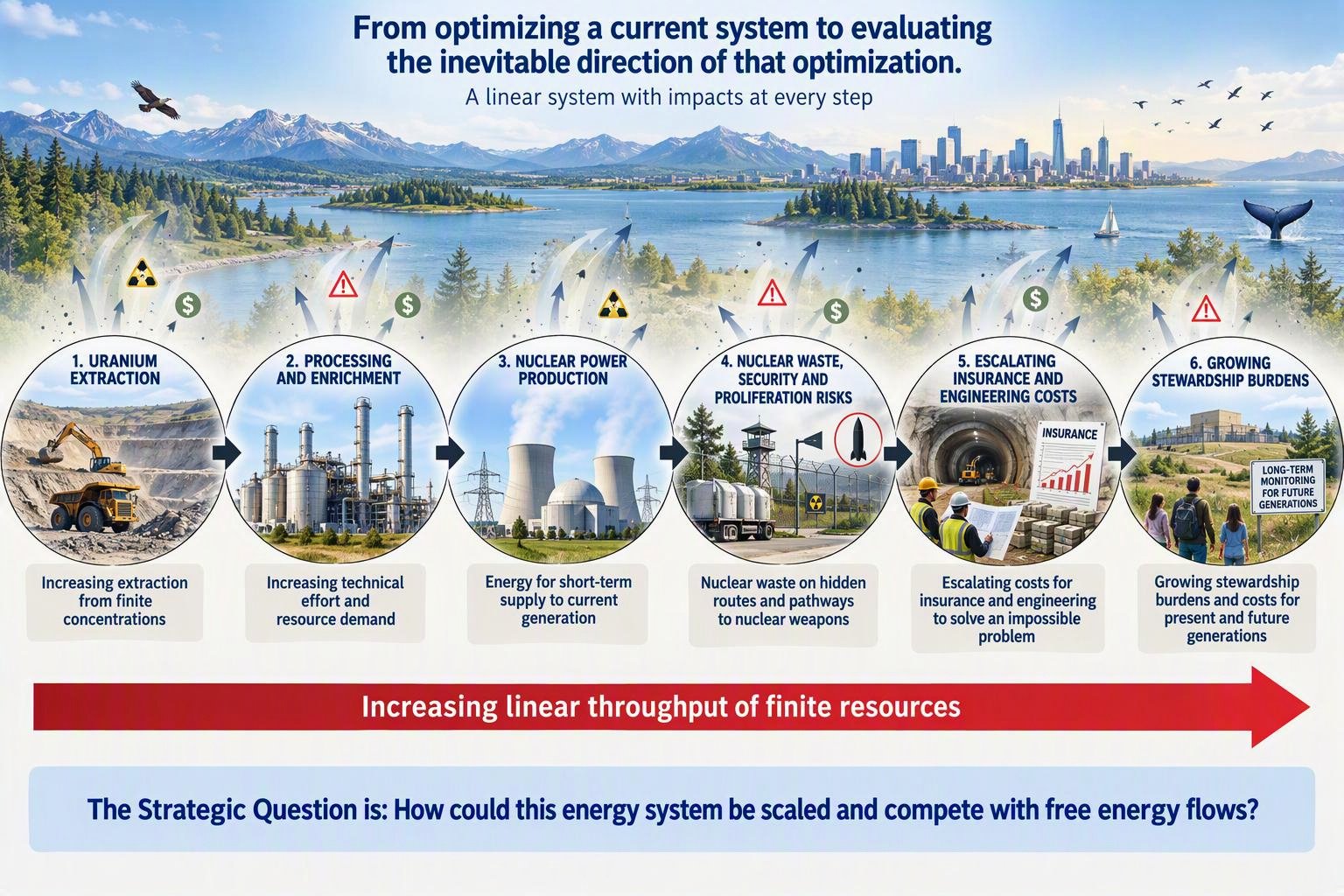
But what happens if humanity continues to build an expanding civilization on more nuclear power, that is sustaining the continual linear flow from extraction of fuels upstream, through consumption of utility at the middle, to management of inevitable downstream consequences?
The answer to that question cannot be found through technological improvements of any kind. For the same reason perpetual motion machines are scientifically impossible. This follows from the very design of the system as such. So, as long as any technical system depends on the continual linear extraction and dispersal of finite resources, the underlying strategic challenge remains, together with the additional impacts generated throughout and beyond the end of the line. The closest analogy is fossil-fuelled energy systems.
However, the same logic does not apply to the metals required for the infrastructure of an electrified society harnessing energy from free eternal flows. Unlike fuels, which are irreversibly consumed when used, metals for construction can remain in circulation through innovative technical, business, and governance systems that organize material flows in increasingly closed loops. Continuing this transition is essential, since substantial quantities of metals are still lost from future use through dissipative and wasteful practices (primarily violating sustainability boundary condition 7), eventually contributing to the growing accumulation of waste in natural systems (primarily boundary condition 1).
More in detail for operatively scrutinizing the linear management of nuclear fuel: the full life-cycle system behind nuclear power can be scrutinized against all eight sustainability boundary conditions. Significant challenges can be identified in relation to each of them, some of which cannot be resolved through technological improvements of the linear model. See fact box below, from where you can test this yourself. Or, for a systematic review of it all, see the full Reflection: https://fssd.global/kalle-reflects/kalle-reflects-on-nuclear-power/
As the scale of extraction of finite nuclear fuels grows, increasingly difficult and costly efforts are required upstream to locate, access, process, and secure remaining resources. At the same time, increasing amounts of dispersed materials, waste streams, and myriad other forms of impact accumulate downstream. Over the long term, pressures therefore will rise at both ends of the chain.
Technological innovation can often reduce these pressures somewhat and temporarily. It can improve efficiency, recover more value from resources, and reduce certain impacts. Such advances are valuable. Yet as long as society continues to depend on increasing linear throughput of finite stocks, the underlying trend remains.
So, should leadership concentrate on improving throughput-dependent systems? Or should it apply a systemic lens to accelerate the shift toward scalable systems powered by free eternal flows?
That distinction is not about ideology.
It is about understanding the difference between (i) optimizing a historic trajectory and (ii) evaluating its inevitable need for redirection.
The former (i) concerns how well we travel.
The latter (ii) concerns where we are headed.
The Framework for Strategic Sustainable Development helps leaders do both: strengthen organizational performance and bottom lines in the near term while accelerating the transition toward solutions capable of serving society indefinitely within the boundary conditions of sustainability.
[1] Fact Box
The FSSD operative system, “ABCD-in-the-Funnel,” is the shared foundation behind Stepwise Global, Stegvis, Kalle’s Reflections, their associated podcasts, and related applications:
Funnel
The term funnel refers to the global context within which ABCD planning takes place. Many essential ecological and social systems are currently in systematic decline and, if current trends continue, will gradually undermine society’s ability to sustain itself. Examples include forests, cropland, groundwater reserves, biodiversity, and social trust.
Boundary Conditions
The funnel opening, representing sustainability for any system, organization, product, project, or society, is operationally defined by eight boundary conditions that are robust for planning. In a sustainable society, nature is not subject to systematically increasing:
- Concentrations of substances extracted from the Earth’s crust (e.g., fossil carbon and metals).
- Concentrations of substances produced by society (e.g., naturally occurring like nitrogen oxides, or synthetic like PFAS).
- Degradation by physical means (e.g., overfishing and large-scale clear-cutting).
And, in that society, people are not exposed to structural barriers to:
- Health (e.g., unsafe working conditions).
- Influence (e.g., referendums leading to change).
- Competence (e.g., access to education and learning).
- Impartiality (e.g., fair representation in rooms of decion making).
- Meaning-making (e.g., opportunities for purpose and contribution).
ABCD
(Not an acronym, but a simple sequence of four steps: A, B, C, and D.)
A = A vision of success, framed within the eight sustainability boundary conditions.
B = An assessment of current reality, including assets and challenges in relation to that vision.
C = A broad range of possible actions that could help bridge the gap between the current situation and the desired future.
D = A prioritized strategic action plan consisting of stepwise measures selected from the C-list.
For deeper exploration, please refer to the resources listed below.
References
The Science Behind the Operative System
Robèrt, K.-H. et al. Operative System for Strategic Sustainable Development: Coordinating Analysis, Planning, Action, and Use of Supports Such as the Sustainable Development Goals, Planetary Boundaries, Circular Economy, and Science-Based Targets, published in Sustainable Development, Volume 33, Issue 4, pp. 4759-4774.S
This paper provides the scientific foundation of the Operative System and includes references to the underlying research and methodology.
For further Reflections, Podcasts, Applications, and Courses
Find all of them on Stepwise Global www.stepwise.global/
The Stepwise Global platform contains a broad range of reflections, podcasts, applications, educational resources, and courses related to strategic sustainable development and the use of the FSSD.
Among the reflections addressing important aspects of the methodology itself, readers may find particular value in:
- Backcasting from Principles: the conceptual foundations and scientific logic of backcasting from sustainability principles with examples. https://fssd.global/kalle-reflects/kalle-reflects-on-backcasting-for-strategic-thinking-and-ways-of-muddying-waters/
- ABCD Workshops and Their Psychology: how the methodology is applied in practice and how group dynamics influence outcomes. https://fssd.global/kalle-reflects/kalle-reflects-on-the-psychology-of-abcd-in-funnel-workshops/
- An Attractive Sustainable World (Step A): Because every system is nested within the larger global system, a model of a sustainable world within the boundary conditions determines the ultimate scalability of any specific organization, project, region, product, or other topic. https://fssd.global/kalle-reflects/kalle-reflects-in-concrete-terms-on-an-attractive-sustainable-world-at-a/
- The C-list of ABCD planning: If the C-list is too thin or superficial, you run into the classic “poor data in, poor results out” problem when you reach D, where actions are prioritized. https://fssd.global/kalle-reflects/kalle-reflects-on-the-c-list/
- The overriding success factor: when leaders are actively involved in intellectual performance https://fssd.global/kalle-reflects/kalle-reflects-on-success-and-failure-respectively-from-the-operative-systemabcd-in-funnel/
- Risky myths about economic growth: https://fssd.global/kalle-reflects/kalle-reflects-on-a-four-headed-elephant-in-the-economic-room/
- Risky myth about low consumption society: fssd.global/kalle-reflects/kalle-reflects-on-low-consumption-society/
These resources provide additional perspectives on the practical implementation of the Operative System and its role in strategic planning for sustainability.