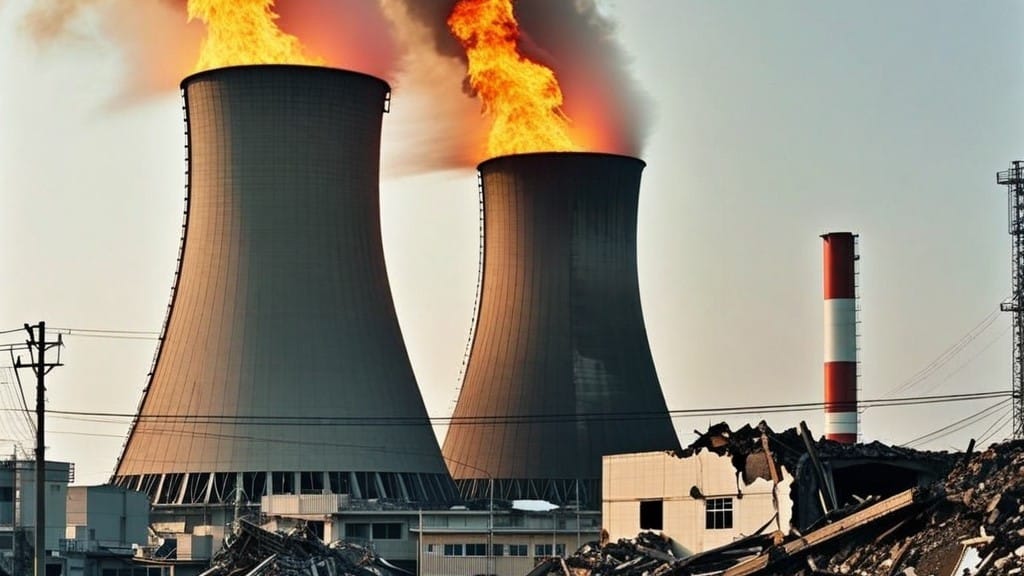
Nuclear Power: Exclusive, Risky Bet for Leaders
Strategic Takeaway for Business Leaders at all Levels Everywhere
Nuclear power is experiencing a political revival in several countries, including Sweden. It is often presented as a solution for both climate mitigation and long-term energy security. Yet when assessed through the lens of Strategic Sustainable Development and the Framework for Strategic Sustainable Development (FSSD), an essentially different picture emerges, with profound implications for nearly all of the arguments currently advanced in the debate.
The central challenge is not reactor safety, technological sophistication, new innovations or even economics.
The challenge is more fundamental.
Nuclear power is built upon a linear flow of finite fuel.
As long as fuel must continually be extracted, processed, transported, consumed, managed as waste, and eventually replaced, the system remains dependent upon a resource base that is inherently limited. This places nuclear power in the same strategic category as all technologies that rely upon the continuous throughput of finite materials.
The issue is therefore not primarily one of risk.
It is one of inevitability.
A society may debate the timing of depletion, the probability of accidents, the size of reserves, or the effectiveness of future technologies.
What cannot be debated is that a finite fuel cycle cannot support an expanding global energy system.
The relevant question is therefore not whether the principle model of nuclear power ultimately reaches its limits, but how much time, capital, and political effort will be invested before those limits become impossible to ignore.
From this perspective, nuclear power resembles a large-scale attempt to postpone a strategic adjustment that must eventually happen anyway.
By contrast, renewable energy systems are built upon perpetual natural flows such as sunlight, wind, hydropower, geothermal energy, waves, and ocean currents. These systems certainly require material investments in infrastructure, as well as ongoing maintenance and innovation. Yet, unlike materials used as fuels, they do not depend upon the continual consumption of finite materials. Rather, the sustainability challenges associated with the required material stocks are matters of innovation, governance, stewardship, and circular material management.
This distinction is fundamental.
One pathway depends on a finite throughput of resources. The other seeks to harvest continuously free and renewed flows while circulating materials in closed-loop systems.
The strategic question therefore becomes straightforward:
Which pathway is more likely to support human civilization indefinitely within the constraints imposed by natural laws?
________________________________________
More in Detail
The Strategic Risk
For leaders, the discussion is not primarily about energy technologies, their risks, or improvements to current models.
It is about which investment trajectories are ultimately inevitable in a sustainable society.
Every major investment decision commits capital, talent, institutions, and public attention to a particular future.
A large investment in nuclear power commits society to extending a finite fuel cycle through incremental improvements and to managing a growing linear chain of long-term obligations. The burden of proof thereby shifts from assessing current risks and their management to demonstrating how long such a trajectory can remain viable as its remaining time horizon inevitably contracts.
As regards cost-benefit, it is often forgotten that civilian nuclear power grew out of technologies originally developed for military purposes. Nuclear weapons remain intimately linked to nuclear plants, enabling a small number of leaders to threaten humanity with catastrophic destruction. This may be the ultimate cost, and one that makes the balance sheet even more difficult to defend.
Organizations that fail to see the need for stepwise progress towards solutions that are attractive, scalable and possible from a natural law perspective will become owners of increasingly expensive and difficult-to-manage assets. Until they must be abandoned at huge costs anyway.
________________________________________
Applying the FSSD: Nuclear Power as a Strategic Test Case
One of the strengths of the FSSD is that it can be applied consistently to any technology, business model, or societal system.
The purpose is not to ask whether nuclear power is preferable to a particular alternative under a particular set of circumstances.
The deeper question is this:
Can nuclear power serve as a permanent component of a sustainable society?
If the answer is no, then the discussion must eventually shift from optimization toward transition.
________________________________________
SP1: Increasing Concentrations of Materials from the Earth’s Crust
Nuclear power begins with the extraction of uranium, a radioactive metal typically found in ore alongside other radioactive elements.
Some leakages of radioactive substances to natural systems are unavoidable already at this stage. Similar challenges persist throughout the remainder of the linear chain, including transportation, fuel processing and handling, cooling-water operations, waste management, and the continuing possibility of accidents, near-miss events, cold and hot wars.
And, like all technologies dependent upon finite mineral resources, larger deployment requires larger rates of extraction and larger material flows throughout the system.
__________________________________
SP2: Increasing Concentrations of Substances Produced by Society
Nuclear processes generate radioactive isotopes requiring management for time periods that often extend far beyond customary political, economic, and institutional horizons. An example is plutonium, which has not existed in the biosphere in anything but trace amounts for approximately half a billion years.
Future reactor designs may undoubtedly improve operational performance in relation to older designs. Some may reduce important safety concerns, improve fuel utilization, or reduce waste volumes.
Yet these principal energy systems share a common characteristic. Beyond the inevitable dispersion of mined materials with extremely long lifetimes into natural systems, they also generate waste streams associated with the second sustainability boundary condition.
Which institutions can reasonably be expected to manage hazardous materials safely across centuries or millennia?
________________________________________
SP3: Physical Degradation of Nature
The impacts of nuclear power extend beyond the reactor itself.
Mining operations, processing facilities, transportation systems, interim storage sites, and final repositories all require land, infrastructure, and continuing management.
Uranium mining regions are examples of landscapes whose future opportunities are increasingly constrained by the legacy of extraction.
_______________________________________
Social Sustainability Principles
The social sustainability principles draw attention to a dimension often overlooked in technical discussions of energy systems.
Nuclear power is not merely an energy technology.
It is also a governance system.
Its operation depends upon institutions capable of maintaining security, safety, regulatory oversight, waste management, international controls, technical competence, mechanisms that ensure costs are borne by plant owners rather than the general public, and public trust across extraordinarily long time horizons.
This raises challenges in relation to each of the five social sustainability principles.
In a socially sustainable society, there are no structural obstacles to:
SP4 Health
For example, exposure risks associated with radioactive materials and long-term waste management responsibilities.
SP5 Competence
For example, dependence upon highly specialized expertise and centralized systems of exceptional technical complexity.
SP6 Influence
For example, the ability to meaningfully assess or participate in decisions shaped by highly specialized knowledge may become increasingly constrained, with implications for regional self-reliance.
SP7 Impartiality
For example, the absence of future generations from decisions whose consequences may persist for hundreds or thousands of years.
SP8 Meaning-Making
For example, the increasing social and ecological tensions across cultures, nations, and value systems that emerge when the violations of all the above seven boundary conditions are transferred across generations. Again, cold wars leading to nuclear arms conflicts may be the ultimate cost, and one that makes the balance sheet even more difficult to defend.
________________________________________
Economics and the Distribution of Costs
What would the economics of nuclear power look like if all foreseeable obligations throughout the fuel cycle were borne exclusively by the beneficiaries of the technology?
The answer matters because sustainable business models must ultimately be capable of carrying their own costs.
________________________________________
The Precautionary Principle Revisited
Nuclear power is frequently discussed through the language of risk.
From a sustainability perspective, many of the central challenges are better understood as predictable consequences of system design.
Waste accumulation is not a risk.
It is inherent.
Fuel depletion is not a risk.
It is inherent.
Long-term stewardship is not a risk.
It is inherent.
Geopolitical dependencies associated with fuel supply are not random events.
They are inevitable consequences of a finite resource dependence upstream, in combination with increasing impacts downstream.
The relevant uncertainty concerns timing and magnitude.
Not direction.
The direction is already embedded within the structure of the system itself.
________________________________________
Transitional Responsibilities for instance related to Thorium
Some nuclear technologies may still play a constructive transitional role.
Thorium-based systems are one example that deserves consideration in this context. In some designs, thorium is used together with mixed waste from conventional nuclear fuel cycles, while the nuclear reactions are sustained by an external neutron source. Such systems have the potential to reduce the longevity and volume of certain waste streams, shortening stewardship requirements from geological timescales to periods measured in centuries. Furthermore, the nuclear reaction is not self-sustaining and can be halted by removing the external neutron source.
This represents a fundamentally different objective than expanding the role of nuclear power as a primary future energy source.
It is not a question of creating a permanent solution.
It is a question of responsibly managing an existing legacy.
________________________________________
Which Sustainability Principle Faces the Greatest Challenge?
If one principle deserves particular attention, it may be SP7: Impartiality.
The reason is simple.
The benefits of nuclear power that we have harvested in the past are largely captured by those living and making decisions today.
Many of the associated obligations are transferred to our children and people who have not yet been born.
Future generations have no opportunity to negotiate the terms under which they inherit waste repositories, monitoring requirements, geopolitical tensions, stewardship responsibilities, and associated costs.
Yet these obligations may remain with them long after the final reactor has stopped producing electricity.
Viewed from this perspective, nuclear power raises an ethical question as much as a technical one:
To what extent is it reasonable for one generation to create long-term obligations that constrain future generations while providing them with no value at all?
Again, this would remain a problematic point of view for any technology, including those that are not already constrained by fundamental scientific limitations.
________________________________________
The Debate
Several arguments are commonly advanced in favor of nuclear power.
Many deserve serious consideration.
Reliability is often highlighted. Grid stability is another common argument. Concerns are also raised regarding material requirements for renewable energy systems.
In light of the above, it is not difficult to see that those arguments turn to their opposites.
Moreover, empirical developments have broadly followed the direction anticipated by theory. Many costs associated with nuclear power have proven difficult to eliminate, while the costs of competing technologies built upon perpetual energy flows have steadily declined. Whether one begins with theory or observation, the trajectory is the same and consistent.
So, the crucial question is not whether future energy systems require materials.
They all do.
The question is which systems are most compatible with circular material flows and long-term sustainability principles.
________________________________________
Leadership in the Transition
Leaders ultimately face a choice between competing trajectories.
One trajectory seeks to extend dependence upon finite fuel cycles through increasingly sophisticated technologies.
The other seeks to accelerate systems built upon perpetual energy flows, circular material management, regional resilience, and decreasing long-term obligations.
Both require innovation.
Both require investment.
Both require leadership.
The crucial question is whether continued technological improvement changes the underlying strategic reality of nuclear power.
From an FSSD perspective, the answer remains no.
________________________________________
Conclusion
Viewed through the lens of Strategic Sustainable Development, the strategic question is not whether nuclear power disappears tomorrow or fifty years from now.
The strategic question is whether scarce capital, institutional capacity, political attention, and human creativity should be invested in extending a fundamentally temporary system, or in accelerating systems capable of operating indefinitely at lower costs within the boundary conditions of sustainability.
Every major investment decision represents a choice between those two trajectories.
From a strategic sustainability perspective, only one of them points toward a future that can continue expanding opportunities without simultaneously expanding obligations.
For leaders, that is the question that ultimately matters.
________________________________________
Fact Box (accompanying all Kalle Comments)
The FSSD Operative System “ABCD-in-Funnel” is the shared foundation behind the organizations Stepwise Global and Stegvis, Kalle’s Reflections and their associated podcasts, and related applications.
Funnel: It refers to that the ABCD planning occurs in a global context, where all vital subsystems are gradually declining, per design, until civilization would not be able to support itself anymore; Forests, Cropland, Water-tables, Biodiversity, Social trust.
Boundary conditions: Eight hands-on conditions for operationally defining the opening of the funnel:
In the sustainable society, nature is not subject to systematically increasing…
1 …concentrations of compounds from the earth’s crust, e.g. carbon dioxide from fossil fuels and heavy metals leaking from society.
2 … concentrations of compounds from societal production, e.g. naturally occurring substances like nitrogen oxides emitted from traffic and agriculture, or persistent compounds foreign to nature like PFAS leaking from consumer goods.
3 …degradation by physical means, e.g. overfishing and large clear-cuts.
…and in that society, people are not exposed to structural barriers to
4. health (e.g. working conditions),
5. influence (e.g. polls),
6. competence (e.g. education programs),
7. impartiality (e.g. composition of boards) and
8. meaning-making (e.g. purposeful missions).
ABCD:
A = Desired future state, modelled within the eight boundary conditions for sustainability.
B = Current reality in relation to A, revealing the gap between present conditions and the desired future.
C = Brainstormed actions capable of bridging that gap.
D = A strategically prioritized action plan derived from the C-list.
For deeper exploration, please refer to the resources listed below.
________________________________________
References
The science of the Operative System with references Operative System for Strategic Sustainable Development—Coordinating Analysis, Planning, Action, and Use of Supports Such as the Sustainable Development Goals, Planetary Boundaries, Circular Economy, and Science‐Based Targets” published in Sustainable Development (Volume 33, Issue 4, pages 4759–4774)
For more Reflections, Podcasts, Applications and Courses in general
https://www.stepwise.global/