Competent green tax shift good for all bottom lines
Sustainable re-design is our only option, and the rest is all about timing. The sooner well informed policies help us prepare and act on this imperative, the better for all, not the least financially. A nice ground for agreements across political parties.
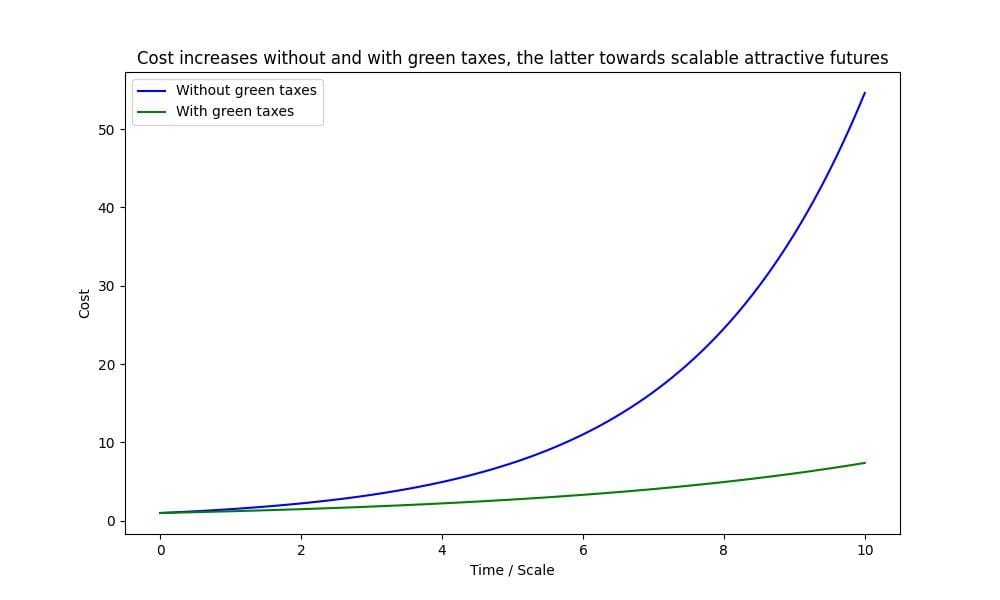
Green taxes on CO2 emissions for example, if politically well designed, would help everybody to soft land on development curves that are inevitable, instead of crash landing on violently increasing cost curves that will follow unsustainable practices. All to get rid of such practices before the crashlandings, of course. Once learning curves and cost curves towards scalable and attractive futures is mainstream, the green taxes can be removed. Whereas the alternative, due to political paralysis, means guaranteed crash landings on exploding cost-increases from social, ecological and financial destruction. The costs show as dead end investments in non-scalable ideas, failures to foresee more and more sustainability driven markets in time, costs for wasteful management of ever more expensive resources, and costs for all kinds of repairs of social and ecological systems. Things that currently plague us all, not the least the obsolete actors themselves.
More in detail:Left-wing leaders in Sweden regularly get stuck on a question that is often asked in the media. “How high must oil prices be set for climate reasons?” As if an increase in these levels could only be achieved through political decisions, and as if the reasons for “greening” would be all about ethics and values.
But the prices of unsustainable practices e.g. fossil- and bio-fuels will go up anyhow, and the prices of electrically powered traffic systems will fall anyhow. Regardless of political decisions. This is due to laws of Nature and logics directly derived from those [1]. In many markets, life cycle costs for ownership of cars powered by electricity from privately owned solar cells, for example, have already intersected with such for fossil cars. And the difference will continue to increase in favor of electrification. The remaining question is when, and to what societal impacts, change will happen. So, already the question about “setting the price” is doubtful and needs to be nuanced to avoid locking-in answers into incorrect assumptions.
- – “What do we know about the relative cost of fuels versus electric propulsion of vehicles?” Answer: that difference will continue to grow in favor of electrification, exponentially, because of laws of nature.
- “So, how much would an ordinary fuel-Traficant need to gain from electrifying their habits sooner rather than later, to make the change in time rather than too late to avoid crash-landings?” Answer: That question is relevant for setting green taxes right, and depends not only on marginal costs, but also on habits, so microeconomic modelling is needed here. Traffic habits have been explored in scientific articles and in practical collaboration between, among others, the top management advisors Sero and Telia, as well as in scientific papers on sustainable traffic modelling for the South of Sweden funded by the Swedish Energy agency [2].
All hot topic Reflections are direct consequences of our Operative System.
For a deeper dive into the science behind the Operative System that informs all Reflections, see the peer-reviewed Open-Source paper with all its references: doi.org/10.1002/sd.3357. For the full title, see footnote [3] below.
Or, for concluding reflections, practical insights and training, click on “Kalle Reflects” to see all reflections.
If you need any further advice, perhaps getting some further references, please send a question to us from the homepage.
Footnotes:
[1] Mainly the first and second laws of thermodynamics, gravity and the matter conversation principle, see previous Kalle reflections and publications on what is scalable and what is dying on future markets.
[2] See publications from Sero, a leading company for sustainability advise on traffic, or Modelling of Sustainable Traffic in the South of Sweden sponsored by e.g. the Swedih Energy agency.
[3] Broman, G. I., & Robèrt, K.-H. (2025). Operative System for Strategic Sustainable Development―Coordinating Analysis, Planning, Action, and Use of Supports Such as the Sustainable Development Goals, Planetary Boundaries, Circular Economy, and ScienceBased Targets. Sustainable Development, 1C16.
We would be happy to send PDF files on demand.