Zombie Capitalism Exposed: Risky Lessons from The Curse
Kalle reflects on Karin Pettersson’s Book Förbannelsen (The Curse)
Takeaways for Leaders at all Levels Everywhere
Economist and parliamentarian Karin Pettersson has written a compelling, self-critical book about the 1990s—a decade that saw the most destructive dismantling of politics in favor of an unchecked capitalism running amok. Like many others, Pettersson was seduced by the mighty force of neoliberalism but, unlike most, she woke up to its devastating aftermath. Her book exposes the neoliberal unraveling behind my own Reflection on the “Elephants in the Economic Room”; for more details, see also this. To avoid spoiling the book—which I strongly recommend you read—this Reflection is framed as a series of essential cliffhangers.
More in detail
The Intellectual Shift That Changed Everything
Several economists received Nobel Prizes for promoting the idea of money before politics—as opposed to money serving democratic governance for the common good. Countless economists and politicians followed the lead of neoliberalism.
Even Adam Smith (1723–90), often called the father of economics, foresaw the danger. While he introduced the concept of the “invisible hand,” he warned that capitalism, unless tamed by politics for a higher social purpose, the horse before the cart, could become destructive. How did a powerful tool for achieving societal goals become the dominant goal itself, the cart before the horse?
This was an intellectual shift within economics—a term that originally meant “householding” of limited resources to achieve goals within the “house” i.e. society within ecosystems. That shift triggered a wave of political deregulation. Institutions and frameworks designed to create and safeguard the welfare state—laws, politics, taxes and norms guiding capital toward societal benefit—were systematically dismantled across all areas: banks, investment firms, the World Bank, political parties, schools, hospitals, IT technologies…
The Consequences
Capital began to flow freely across the globe at the speed of light, digitized and serving the laissez-faire ideal Adam Smith warned against. The prevailing myth was that this unleashed power, free from political influence, would create wealth like a rising tide lifting all boats—including those of the poor.
One extreme example: mathematicians employed by financial institutions developed algorithms that claimed to generate money out of nothing. In boardrooms worldwide, sophisticated mathematics suffocated skepticism. Banks used these models to chase mathematically created money or sell incomprehensible products—even to customers who didn’t understand them, including the mathematicians themselves. The zombie capitalism in a nutshell.
Politicians across the spectrum abandoned ideological roots to pledge allegiance to these ideas. In unholy alliances with economic and industrial advocates, they became enablers—or even champions—of this paradigm, sawing off the very branch they sat on. Politics, once committed to advancing democracy beyond feudalism through laws and norms for fairness , largely surrendered its raison d’être.
Powerlessness followed. Bubbles of mythological belief burst repeatedly in huge crises. Economic growth had always cycled through booms and busts, but clever regulations once softened the blows and halted the drifting apart between “haves” and “have-nots”. When those measures failed perfection, this was used as an excuse to abandon regulation entirely.
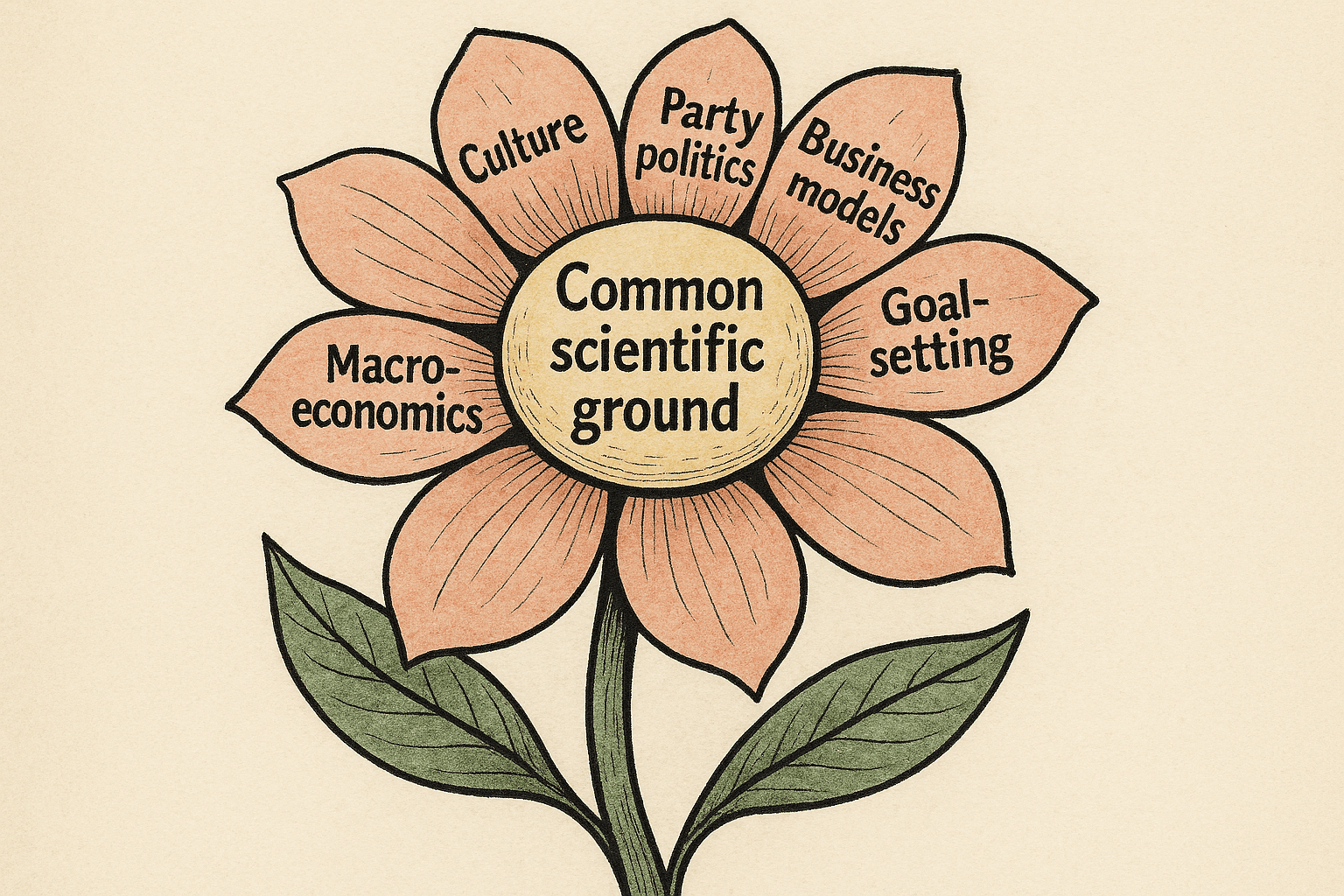
This is not only saddening from a societal, industrial, or economic point of view, it is devastating to politics from all parties themselves. At best, politics across parties have agreed on certain common ground for instance natural laws, logic, and the Golden Rule. Such agreement enables democratic processes to weigh competing value systems seriously. That foundation of decensy, also making values and party politics clearer in outline, was eroded.
So, What’s the Good News?
There is no good news in these developments but there is hope. Strategic thinking aligned with natural laws and translated into clear logic shows that even those who profit short term from exploitation—yes, even criminals with “blood money”—would gain from investing in sustainable solutions: energy, transportation, material flows, forestry, agriculture, and human resources within the boundaries of sustainability.
The alternative, even for the most ruthless actors, is a future on a vast garbage dump, presiding over a society in despair, scrambling to survive amid the social, ecological, and financial wreckage created since the 1990s. Is that a future worth dreaming of, for anyone?
All hot topic Reflections are direct consequences of our Operative System.
For a deeper dive into the science behind the Operative System that informs all Reflections, see the peer-reviewed Open-Source paper with all its references: doi.org/10.1002/sd.3357. For the full title, see footnote below.
Or, for concluding reflections, practical insights and training, click on “Kalle Reflects” to see all reflections.
If you need any further advice, perhaps getting some further references, please send a question to us from the homepage.
Footnote: Broman, G. I., & Robèrt, K.-H. (2025). Operative System for Strategic Sustainable Development―Coordinating Analysis, Planning, Action, and Use of Supports Such as the Sustainable Development Goals, Planetary Boundaries, Circular Economy, and ScienceBased Targets. Sustainable Development, 1C16.