A Reflection on How Greater Use of Circular Economy Can Be Achieved by Recognizing Its Limits
A Lens Through Which to Read This Reflection
- Circular Economy (CE) is a valuable approach to improving the management and capitalization of material flows.
- However, sustainability also requires answers to questions that CE cannot provide:
- How much recycling is needed for a given material to comply with FSSDs absolute boundary conditions of sustainability?
- In line with first point, which materials must be phased out rather than recycled?
- Which of the remaining and dominant sustainability challenges have little or nothing to do with society’s material flows?
- When placed within a broader framework for sustainability, CE becomes a powerful contribution to a much larger systemic transition.
Takeaway for Leaders at All Levels
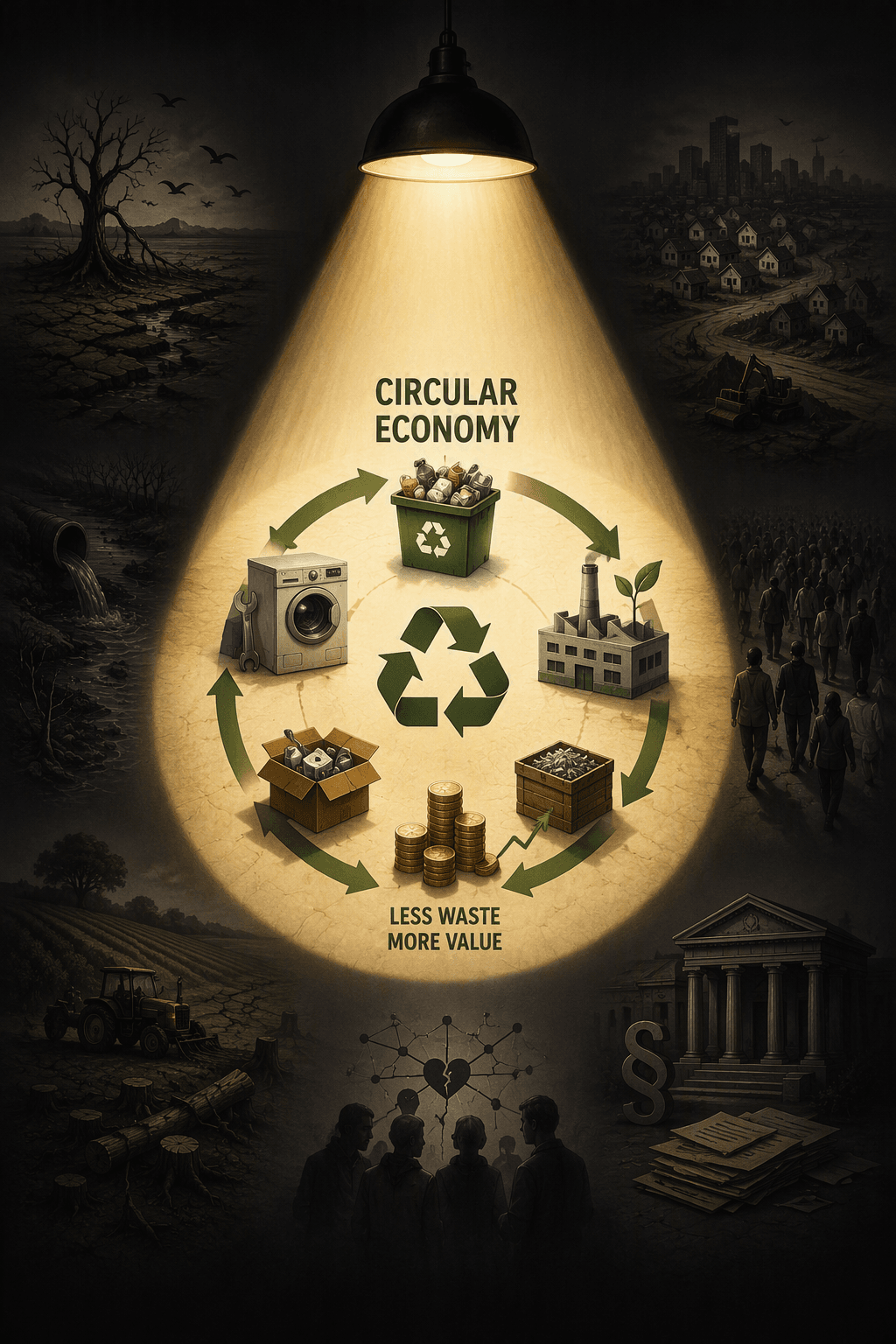
“Circular Economy” is a relatively recent addition to the sustainability vocabulary. The concept gained broad recognition through the Ellen MacArthur Foundation and the influential 2012 report prepared in collaboration with McKinsey. CE is generally presented as an approach to making material flows in business and society more sustainable through reuse, remanufacturing, recycling, and other forms of circular resource management.
The underlying ideas are not new. Discussions of cyclical material flows date back decades and have long been explored within fields such as Industrial Ecology. This raises an interesting question: What explains the remarkable growth of the Circular Economy movement in recent years? Why has it inspired conferences, networks, strategies, and implementation efforts around the world?
One reason is that the concept has helped make sustainability opportunities more tangible for business leaders. The Ellen MacArthur report illustrates clearly how organizations can reduce costs and improve resource productivity through greater reuse and recycling. The business case is well presented and easy to understand.
For those using the FSSD Operative System and the ABCD planning process, CE can be viewed as another useful “app” within the broader framework of strategic sustainable development (see fact box below, and for further references, please only look at References found on this platform, e.g. any of the ones in the Reference list below). It can help organizations identify opportunities for improved resource productivity and more circular material management at every stage of the ABCD analysis, while simultaneously improving economic performance.
Questions might include:
- Where does our ABCD analysis reveal opportunities for CE i.e. recycling, reuse, or remanufacturing? Perhaps at the setting of goals (A)? Or at our current situation (B) where we may find new challenges related to CE? Challenges that may be addressed as possible measures further ahead (C), perhaps even deserving a high priority (D) in our journey towards A?
- Have we fully explored the opportunities to capitalize on this analysis?
More in detail
It is not in the interest of CE proponents that the concept is used for purposes it is not designed for. So, how do we keep the above business case distinct from the risks? The opportunities offered by more efficient material flows through CE must not reduce our focus on the many critical sustainability questions that lie beyond its scope. This calls for a clear understanding of several important issues:
- How Much Recycling Is Enough?
Perhaps the most important question regarding material flows is not how to capitalize on increased cyclic flows, but whether such efforts can increase sufficiently to remain within the FSSDs robust boundary conditions for scalable investments toward attractive future scenarios of anything everywhere.
Different materials require different degrees of circularity if society is to remain within the boundary conditions of sustainability. This question can only be addressed through rigorous modelling within those boundary conditions. At one end of the spectrum we find compounds that degrade so slowly that even minimal leakages into nature cause them to accumulate over time towards and beyond critical thresholds. At the other end are substances that may be harmful even at relatively low concentrations but degrade so rapidly after entering nature that they do not accumulate there. Acetone is one example of such a substance. In such cases, the primary sustainability challenge may shift from ecological accumulation towards social impacts, for example those related to Health (Boundary Condition 5). Simply classifying substances as “toxic” or “non-toxic” therefore offers limited guidance. Everything becomes toxic to organisms, or ecotoxic to the biosphere, when concentrations exceed their respective thresholds for harm. This calls for analysis and modelling within the FSSD boundary conditions. Such analysis must precede economic and other strategic considerations. “Recycling more than before,” “recycling as much as possible,” or “recycling whenever it saves money” are not, by themselves, solutions to the sustainability challenge.
- Which Materials Should Be Phased Out?
Some materials are so difficult, hazardous, or uneconomic to manage within the boundary conditions of sustainability that they should not simply be circulated more efficiently. Instead, they should gradually disappear from normal societal use. This may involve abandoning them totally in consumer products where recycling rates will never approach 100 percent. Or eliminating them entirely if modelling within sustainability boundary conditions indicates that this is necessary.
CFCs in consumer products such as refrigerators and air conditioners provide a familiar example. In such cases, the strategic question is not how to recycle the material, but how to provide equal or better societal value through alternatives compatible with sustainability requirements. See, for instance, my reflection on how Electrolux addressed its CFC challenge ahead of competitors while simultaneously strengthening its competitive position and profitability.
A sustainability framework must therefore address substitution and phase-out strategies in cases where increasing circularity alone will not suffice.
- Which Sustainability Challenges Are Not About Flows?
Many sustainability challenges are not primarily related to material flows.
Examples include:
- Soil degradation caused by excessively heavy machinery.
- Ecologically destructive forestry practices such as oversized clear-cuts.
- Unsustainable fishing methods.
- Loss of fertile land, including farmland and forests, due to inadequate spatial planning, urban sprawl, and underperforming infrastructure development.
These issues concern how society manages ecosystems and landscapes at a higher systemic level, not merely how it manages material flows.
- Which Economic and Social Factors Are Missing?
The quality of social systems matters profoundly for sustainability.
Questions relating to loss of trust, captured within the five social sustainability boundary conditions of the FSSD (structural obstacles to Health, Competence, Influence, Impartiality and Meaning-making), cannot be adequately understood through a circular-flow perspective. Amongst those we find aspects that are equally important to account for as any economic element, e.g. public policy instruments and laws. Extensive evidence suggests that large income disparities are so consistently associated with reduced trust and a range of related social challenges that they may serve as a useful proxy for declining social trust.
- Four essential risks of not fully grasping the above
The purpose of this reflection is not to criticize Circular Economy. On the contrary, in line with the discussion above, it is to help make greater use of its strengths by avoiding misunderstandings regarding what it can and cannot accomplish.
* One overriding concern relates to the word economy itself.
The economy is not an end in itself. Unlike ecological and social systems, which ultimately define the conditions under which civilization can prosper, the economic system is entirely a human construct. It is one of many tools available for pursuing broader societal goals.
In contemporary societies, however, economic reasoning is often treated not merely as a useful tool, but as the dominant lens through which public issues should be evaluated. This tendency is sometimes described as economism. The concern underlying this term is straightforward: the life-supporting prerequisites for scalable progress towards attractive futures should be monitored and managed directly through absolute boundary conditions for (re)design, rather than through economic indicators or any other indirect measure.
The logic is similar to that of personal finances. We may decide that a particular goal is desirable and then ask whether we can afford it and how our finances might best support that objective. The goal comes first; the economy serves as a means of achieving it. The horse before the cart.
When this distinction is overlooked, new concepts frequently emerge that seek to redefine the economy while continuing to treat it as a supreme objective. Examples include:
• Steady-State Economy
• Green Economy
• Ecological Economy
• Bioeconomy
• True-Cost Economy
Circular Economy risks becoming another concept in this group of ambitious hopes followed by disappointment, unless its role is clearly understood as one important contribution within a much broader sustainability agenda.
* Land Use and Spatial Planning
Some sustainability challenges are fundamentally questions of land use rather than material flows.
As society transitions away from dependence on all unsustainable energy sources, the importance of land and spatial planning will become increasingly evident. Humanity’s future resource base will ultimately depend on its ability to capture primary energy from nature’s continuous and inexhaustible energy flows (solar, wind, geothermal, hydro, waves and ocean currents), activities that are inherently dependent on available land and sea area.
Attention will therefore increasingly shift toward how land is allocated and prioritized through effective spatial planning. This includes balancing several highly space-demanding functions including, in descending order of strategic priority:
- Nature itself, with its biodiversity and life-supporting ecological cycles.
- Food production for a global population may not stabilize until reaching approximately ten billion people.
- Sustainable production of materials and renewable energy.
- Infrastructure.
Or, put differently: What would it take to provide a high quality of life for around ten billion people while simultaneously preserving biodiversity, climate stability, and ecosystem resilience? The order of priorities is strategic rather than arbitrary. Nature’s life-supporting systems must come first, because all other functions depend upon them. Food production must come second, because a growing global population must be fed before land can be allocated to less essential purposes.
Circular Economy can contribute valuable insights to such discussions, but only when embedded within this broader system’s perspective.
A revealing example concerns biofuels. Their appeal often stems from the fact that, unlike fossil fuels and nuclear fuels, the carbon involved circulates within visible biological cycles. Emitted CO₂ can be reabsorbed through biological processes and thus participate in a larger natural cycle than the technical material cycles of society. Yet once competing demands for land, including food production, biodiversity conservation, forestry, and other ecosystem services, are taken into account, biofuels cannot become a scalable component of civilization’s future energy system.
* Humanization
Research has repeatedly demonstrated such strong associations between large income disparities and a range of social challenges associated with erosion of trust that income inequality can serve as a remarkably robust proxy for societal trust. Examples of harm associated with erosion of trust include corruption, segregation, crime, reduced social mobility, weakened social cohesion, reduced cooperation, lower creativity, higher transaction costs, and weakened institutional legitimacy. Again, Circular Economy may have something to contribute here, but only as a minor element of change.
* Profits Beyond Material Flows
One of the most overlooked economic opportunities associated with sustainability lies beyond resource efficiency.
The greatest business opportunities are often found in innovation and in the levels of trust that enable innovation to flourish.
As ecological and social pressures increase, entirely new markets emerge. Organizations innovatively capable of providing products, services, technologies, and business models that are compatible with the boundary conditions of the FSSD will increasingly enjoy significant competitive advantages.
The economic gains achieved through improved circular material flows therefore represent only a fraction of the opportunities available through strategic sustainable development.
Concluding Remarks
Today, we have access to scientifically grounded methods that enable organizations to understand, communicate, and manage strategic transitions toward attractive organizational and societal goals within the full scope of ecological and social sustainability.
Circular Economy is best understood as one valuable contribution, an “app” within this larger Operative System framework (for more reading, see Reference list below where the Operative System has been used to perform a SWOT analysis of some concepts including CE). When treated as the dominant lens for sustainability, it risks encouraging overly narrow interpretations of a challenge that is inherently systemic.
[1] Fact Box
The FSSD Operative System “ABCD-in-Funnel” is the shared foundation behind the organizations Stepwise Global and Stegvis, Kalle’s Reflections and their associated podcasts, and related applications.
Funnel: It refers to that the ABCD planning occurs in a global context, where all vital subsystems are gradually declining, per design, until civilization would not be able to support itself anymore; Forests, Cropland, Water-tables, Biodiversity, Social trust.
Boundary conditions: Eight hands-on conditions for operationally defining the opening of the funnel: In the sustainable society, nature is not subject to systematically increasing…
1 …concentrations of compounds from the earth’s crust, e.g. fossil coal and metals.
2 … concentrations of compounds from societal production, e.g. nitrogen oxides and CFCs..
3 …degradation by physical means, e.g. overfishing and large clear-cuts.
felt as self-evident as gravity.”
…and in that society, people are not exposed to structural barriers to
4. health (e.g. working conditions),
5. influence (e.g. polls),
6. competence (e.g. education programs),
7. impartiality (e.g. composition of boards) and
8. meaning-making (e.g. purposeful missions).
ABCD, not an acronym but a sequence of backcasting starting with A.
A = Desired future state, modelled within the eight boundary conditions for sustainability.
B = Current reality in relation to A, revealing the gap between present conditions and the desired future.
C = Brainstormed actions capable of bridging that gap.
D = A strategically prioritized action plan derived from the C-list.
For deeper exploration, please refer to the resources listed below.
________________________________________
References
The science of the Operative System with references
Operative System for Strategic Sustainable Development—Coordinating Analysis, Planning, Action, and Use of Supports Such as the Sustainable Development Goals, Planetary Boundaries, Circular Economy, and Science‐Based Targets” published in Sustainable Development (Volume 33, Issue 4, pages 4759–4774)
Related “Kalle Reflects” of relevance for this particular one on Circular Economy, for example…
- ABCD-in-Funnel planning
- The four-headed Elephant in the Economic room.