Kalle Comments on the vulnerability of fuel dependencies
Takeaway for leaders at all levels everywhere
The escalating geopolitical instability of our time exposes a fundamental vulnerability: the world’s continuing reliance on linear processes from social and ecological resources to waste of all kinds. This Comment focuses on one such case: the linear processing of finite fossil and nuclear fuels. By the laws of nature, continued dependence on linear flows of fuels cannot scale into a sustainable future. Yet global leadership still fails, remarkably, to connect this obvious reality to today’s crises, despite mounting evidence that insufficient foresight has contributed to our current predicament. The strategic implication is straightforward: every crisis exposing the vulnerability of finite-fuel dependence should accelerate, rather than delay, the transition toward energy systems that can actually scale into the future.
More in detail
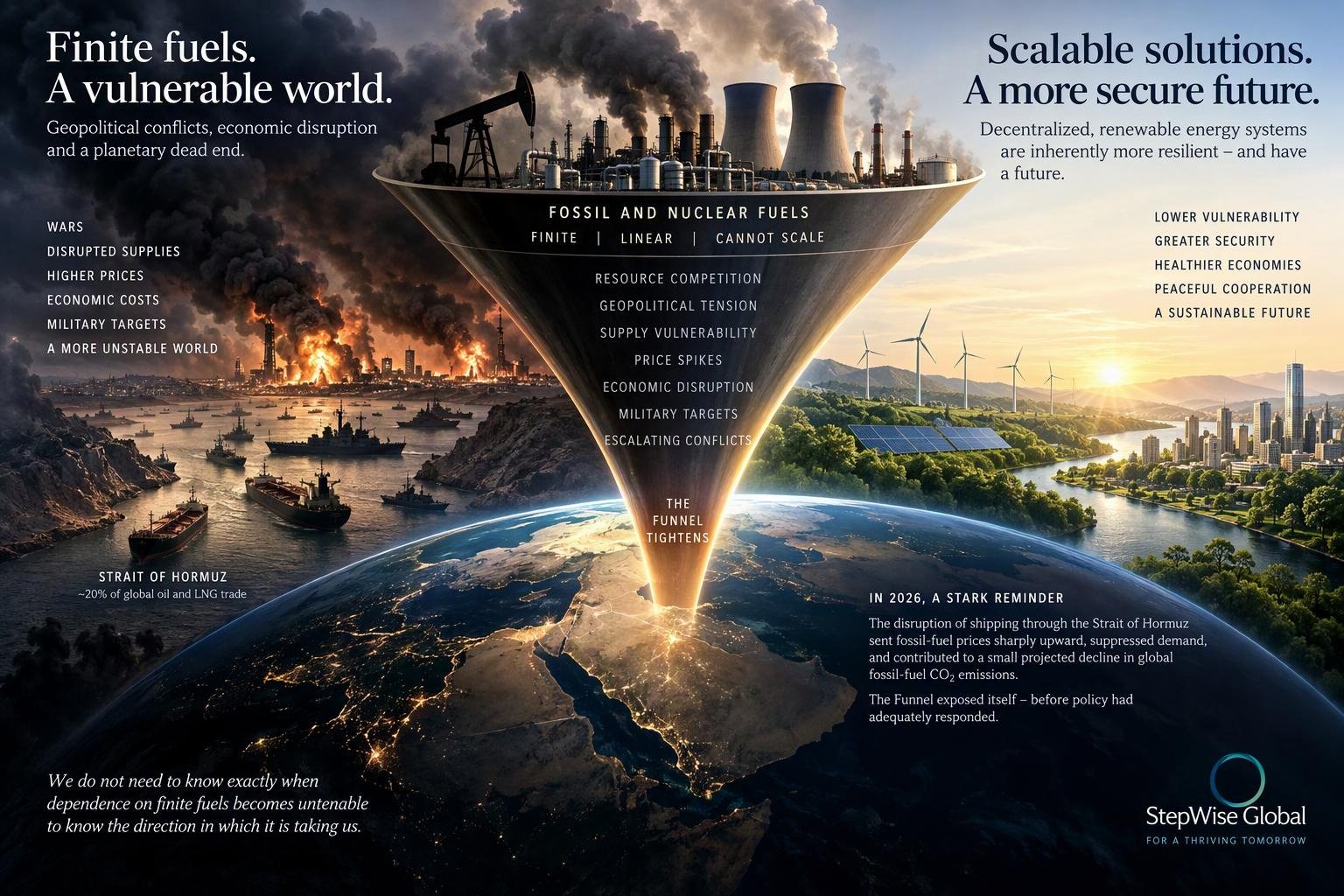
Now, in 2026, reality has provided an unusually stark demonstration. The disruption of shipping through the Strait of Hormuz sent fossil-fuel prices sharply upward, suppressed demand, and contributed to a small projected decline in global fossil-fuel CO₂ emissions. This is hardly the kind of emission reduction anyone should celebrate: it has come with the “funnel-wall” – the inevitable shrinking potential for social and ecological systems to sustain us. In this case demonstrated as war over finite resources, infrastructures around fuels, economic disruption and enormous associated costs. In this case, the Funnel exposed itself before policy had even remotely responded.
Why? The only reason I can think of is the uncertainty about when exactly our finite energy system will reach its inevitable collapse, in fact not a legitimate justification to continue down the same path. Quite the opposite, of course.
Unless leadership recognizes and acts on these lessons, societies will continue to face rapidly escalating consequences, from worsening impacts on social and ecological systems, through intensifying wars, to the erosion of diplomacy and the rise of increasingly aggressive public discourse.
Previous Reflections have shown why fossil and nuclear fuels cannot scale in accordance with the laws of nature, just as perpetual motion machines cannot exist. Despite this, one of the many escalating consequences of these linear systems now appears with renewed clarity: their vulnerability in times of conflict, as well as their role as drivers of conflict and military targets.
The Russia-Ukraine and Middle East wars illustrate this with painful precision. They revolve around access to finite resources such as land and fuels, disrupt the global economy, and use both fuel supplies and the infrastructure of linear energy systems as strategic targets. These connections are evident, painfully so, to anyone willing to look beyond the next election cycle. Yet world leaders, geopolitical institutions, and national authorities still fail to connect the dots. They seldom acknowledge how insufficient foresight and planning in the past have contributed to the crises we now face.
They should be saying:
“We are witnessing yet another example of geopolitical instability driven by dependence on finite fuels. By the laws of nature, such energy systems have literally no future. And the closer we move toward their inevitable collapse, the more severe the impacts become, regardless of exactly when the final crash occurs.”
Instead, uncertainty about the precise timeline is used as an excuse to continue down this self-defeating path. Yet the uncertainty regarding the exact timeline to the abyss, combined with the inevitably increasingly painful trajectory to get there, ought, in all reason, to be the strongest possible motivation for urgent redirection. Every penny spent prolonging fuel dependency is a penny diverted from advancing the energy systems that do have a future, systems that are not only inherently scalable but also markedly less vulnerable due to their decentralized structure.
To avoid repeating the leadership failures that brought us here, these lessons must be recalled whenever we confront the growing consequences of earlier inaction. The wars escalate, while the younger generation of leaders, distanced from the realities of past world wars, underinvests in diplomacy, a neglect that should trouble us all, given history’s lessons. Meanwhile, public discourse increasingly revolves around aggression, a distressing sign of how easily societies forget the wisdom that past suffering once taught, seeing the mote in a neighbor’s eye while ignoring the beam in one’s own. The alarming thing is in the alarming itself, getting more attention than consideration. It is a vicious cycle. But it is not inevitable.
And this is perhaps the most useful bottom line for leaders: we do not need to know exactly when finite-fuel dependency will become unbearable to know that its direction is strategically wrong. The task is therefore not to predict the abyss more precisely, but to redirect development, step by step, toward systems that can actually scale into the future. Breaking the vicious cycle begins by seeing it, and daring to break it strategically.
Want to listen to the podcast about this comment? https://shows.acast.com/68c6a8718b1c6a4828eaa658/6ae849f2c89efe58660f5bd7
Below, see Fact Box to test this Comment.
[1] Fact Box
The FSSD operative system, “ABCD-in-the-Funnel,” is the shared foundation behind Stepwise Global, Stegvis, Kalle’s Reflections, their associated podcasts, and related applications:
Funnel
The term funnel refers to the global context within which ABCD planning takes place. Many essential ecological and social systems are currently in systematic decline and, if current trends continue, will gradually undermine society’s ability to sustain itself. Examples include forests, cropland, groundwater reserves, biodiversity, and social trust.
Boundary Conditions
The funnel opening, representing sustainability for any system, organization, product, project, or society, is operationally defined by eight boundary conditions that are robust for planning. In a sustainable society, nature is not subject to systematically increasing:
- Concentrations of substances extracted from the Earth’s crust (e.g., fossil carbon and metals).
- Concentrations of substances produced by society (e.g., naturally occurring like nitrogen oxides, or synthetic like PFAS).
- Degradation by physical means (e.g., overfishing and large-scale clear-cutting).
And, in that society, people are not exposed to structural barriers to:
- Health (e.g., unsafe working conditions).
- Influence (e.g., referendums leading to change).
- Competence (e.g., access to education and learning).
- Impartiality (e.g., fair representation in rooms of decion making).
- Meaning-making (e.g., opportunities for purpose and contribution).
ABCD
(Not an acronym, but a simple sequence of four steps: A, B, C, and D.)
A = A vision of success, framed within the eight sustainability boundary conditions.
B = An assessment of current reality, including assets and challenges in relation to that vision.
C = A broad range of possible actions that could help bridge the gap between the current situation and the desired future.
D = A prioritized strategic action plan consisting of stepwise measures selected from the C-list.
For deeper exploration, please refer to the resources listed below.
References
For further Reflections, Podcasts, Applications, and Courses, Find all of them on Stepwise Global containing a broad range of reflections, podcasts, applications, educational resources, and courses related to strategic sustainable development and the use of the FSSD. https://www.stepwise.global/
Among the reflections addressing important aspects of the methodology itself, readers may find particular value in:
- Latest peer-reviewed paper. This paper provides the scientific foundation of the Operative System and includes many more references to the underlying research and methodology. https://doi.org/10.1002/sd.3357
- The scientific background to the above paper, presented as an easy read of physics and chemistry https://fssd.global/kalle-reflects/kalle-reflects-on-how-the-laws-of-nature-underpin-the-logic-of-the-operative-system/
- Backcasting from Principles: the conceptual foundations and scientific logic of systems thinking through a lens of purpose. https://fssd.global/kalle-reflects/kalle-reflects-on-backcasting-for-strategic-thinking-and-ways-of-muddying-waters/
- The psychology of ABCD Workshops: how the methodology is applied in practice and how group dynamics influence outcomes. https://fssd.global/kalle-reflects/kalle-reflects-on-the-psychology-of-abcd-in-funnel-workshops/
- An Attractive Sustainable World (Step A): Because every system is nested within the larger global system, a model of a sustainable world within the boundary conditions determines the ultimate scalability of any specific organization, project, region, product, or other topic. https://fssd.global/kalle-reflects/kalle-reflects-in-concrete-terms-on-an-attractive-sustainable-world-at-a/
- The C-list of ABCD planning: If the C-list is too thin or superficial, you run into the classic “poor data in, poor results out” problem when you use the Operative System.
- The overriding success factor: when leaders are actively involved in intellectual performance https://fssd.global/kalle-reflects/kalle-reflects-on-success-and-failure-respectively-from-the-operative-systemabcd-in-funnel/
- Economic growth: An overview of the current mis-informed discussion on economic growth, outlining two ditches as well as the high-road between them. https://fssd.global/kalle-reflects/kalle-comments-on-four-headed-elephant-in-the-economic-room/
- The Plato cave and the psychological resistance amongst economists to take part in the development of a smarter economy, taking the above reflection seriously. https://fssd.global/kalle-reflects/kalle-reflects-on-the-plato-cave/
- Reporting aligned with the FSSD: The typical lack of “strategic indicators” makes reporting meaningsless. https://fssd.global/kalle-reflects/kalle-comments-on-eu-directives-for-sustainability-reporting/
- Ethics vs. criminals gaining from FSSD thinking, Enlightened self interest https://fssd.global/kalle-reflects/kalle-reflects-on-a-new-dawn-for-oligarchs/
- FSSD planning for social sustainability. https://fssd.global/kalle-reflects/kalle-reflects-on-social-sustainability-from-boundary-conditions-to-systemic-systematic-and-strategic-progress/
- The leading global example of supply chain management in the chemical industry? https://fssd.global/kalle-reflects/reflection-on-polymers-and-their-role-in-turning-current-destruction-into-scalable-solutions-for-the-future/
These resources provide additional perspectives on the practical implementation of the Operative System and its role in strategic planning for sustainability.
Karl-Henrik Robèrt
Professor
Blekinge Institute of Technology
Campus Gräsvik,Valhallavägen 1
SE-371 79 Karlskrona, Sweden
Phone: +46 455385000
Blekinge Institute of Technology helps you take strategic steps toward sustainability!
Research for Real Change | Training for Leaders | Coaching for Role Models | A Movement for Change