Kalle Comments on Strategic speed vs. Haste; Podcast at https://shows.acast.com/68c6a8718b1c6a4828eaa658/6b086024c356f28bdbd58ed2
As many followers of the Framework for Strategic Sustainable Development (FSSD) have already recognized, one major driver of underperformance is detail at the expense of overview. Or, as the saying goes, “The devil is in the details.”
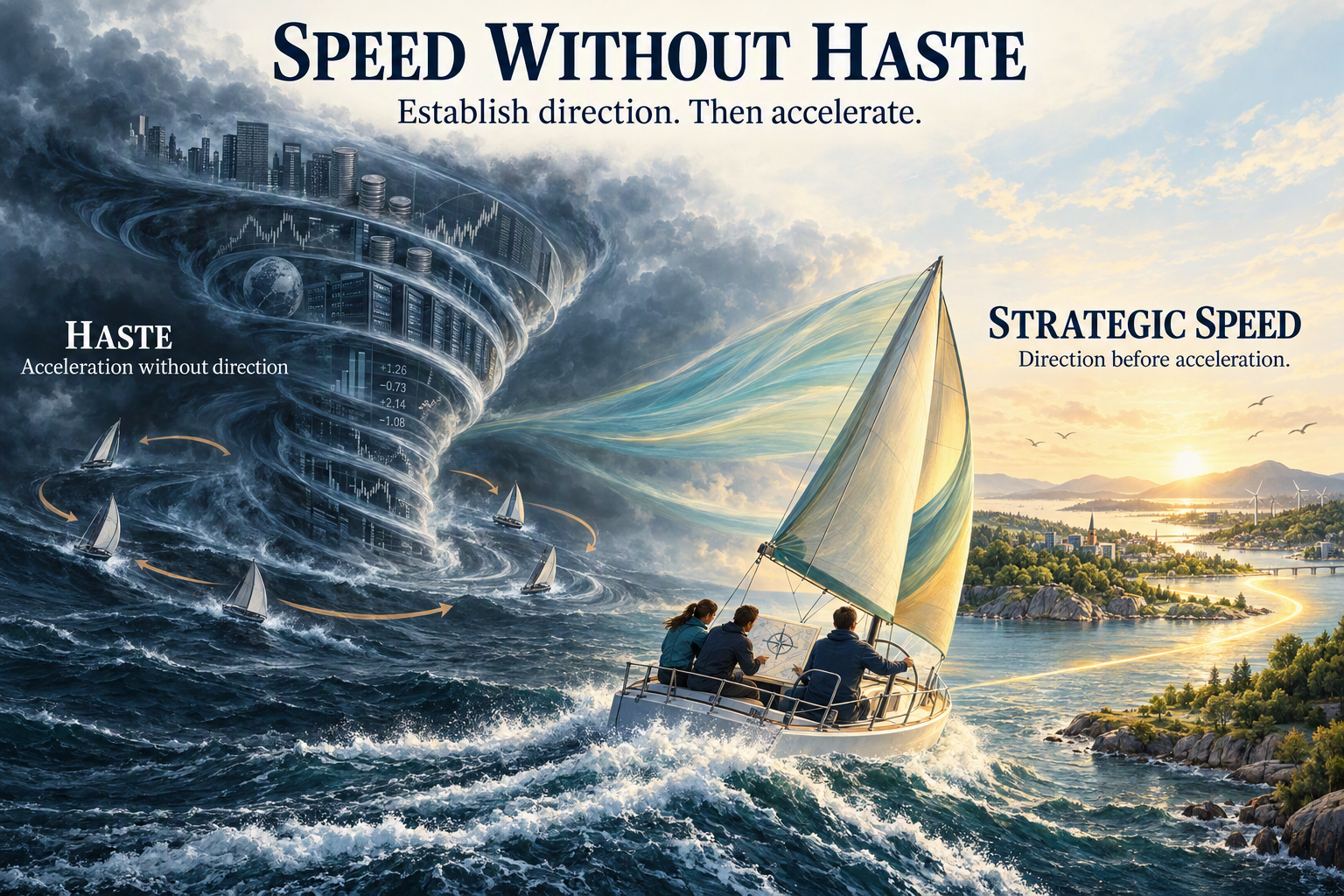
But perhaps the devil is also in haste.
The two are closely related, almost like communicating vessels. Haste drives us into details before we have secured the overview needed to know which details actually matter. And once absorbed in those details, we become even less inclined to step back and ask where we are going.
Haste is therefore not merely a shortage of time. It becomes a strategic handicap when it makes us optimize the speed of movement before establishing whether we are moving in a direction that can succeed.
Speed, in other words, is not the enemy. Speed in the wrong direction is. Once a strategically sound direction has been established, moving fast may be highly desirable. On that condition, speed can actually be part of strategic quality.
In Swedish we have an idiom for this: “Skynda långsamt”, literally, “Hurry slowly.” The paradox captures the point beautifully: move with urgency, but not before you know where you are going.
Many leaders understand this intellectually. They recognize that slowing down just enough to think strategically would often be an act of enlightened self-interest, leading to desirable goals faster than hasty decisions of poor strategic quality. Yet doing so often requires knowledge, training and boldness, and the momentum that grows from combining them. Or, in other words, the capacity to resist powerful mainstream pressures in markets and organizations.
Why, then, have those pressures toward haste become so dominant?
There are probably many mechanisms. But one deserves particular attention: the rapidly growing gaps between the haves and have-nots, at a time when ownership of capital and technology is increasingly concentrated. Economic power can begin to resemble a tornado, sucking up ever more resources and influence while increasing the pressure on everyone around it to move faster simply to remain competitive.
So, brilliant ideas may simply be deprived of the resources, time and attention they need to develop, while enormous flows of capital accelerate into vicious cycles to command the market’s attention.
Today, one of the most visible manifestations of this can be found around Big Tech and AI.
Consider the recurring discussion about an “AI bubble.” The mainstream question is primarily short-term financial: Will today’s enormous investments in AI generate the expected returns, or will the bubble burst? The deeper question of whether the investments themselves are strategically sound is far less prominent. Meanwhile, herd psychology reinforces the pressure to move rapidly, invest before others do, and hope for the best.
So, whether today’s extraordinary flows of money are strategic in a deeper sense is rarely at the Centre of the discussion. Media, investors, businesses and governments are understandably preoccupied with who will win the AI race, where the next breakthrough will occur, and which investments will pay off fastest.
So, what can we do?
The overall answer has already emerged from the reasoning above. Leaders need sufficient knowledge, training and boldness, and the momentum created when those reinforce each other, to resist pressures for short-term optimization when those pressures undermine strategic direction.
Several earlier Comments point toward practical ways of building that momentum:
1. Use AI strategically.
Use AI as much as possible, but not merely to do today’s things faster. Use it to help identify, model and develop solutions that have the potential to scale within the boundary conditions of a sustainable future.
See:
AI and money:
https://fssd.global/kalle-reflects/kalle-comments-on-ai-knives-and-money/
Special challenges of the financial industry:
2. Join forces with others travelling in the same strategic direction.
Individuals and organizations acting alone can easily be overwhelmed by mainstream pressures. Collaboration among people who understand the strategically scalable direction can provide the knowledge, confidence and leverage needed to withstand them and accelerate solutions that can actually become part of the future.
3. Appeal to enlightened self-interest, also among today’s most powerful actors.
Even oligarchs and others controlling enormous concentrations of capital have much to gain from learning to navigate between Scylla and Charybdis: between losing position in the short term on the one hand, and on the other contributing to systems that progressively undermine the ecological and social conditions on which their own prosperity ultimately depends.
Their power gives them exceptional opportunities to contribute to transitions that are strategically viable. And enlightened self-interest provides every reason to do so.
See:
A New Dawn for Oligarchs:
https://fssd.global/kalle-reflects/kalle-reflects-on-a-new-dawn-for-oligarchs/
But what about those outside the tornado?
There is one important question left by the tornado analogy. What about brilliant people with brilliant and scalable ideas, but thin wallets? If money and attention are increasingly sucked up toward already powerful actors, how can strategically valuable ideas outside those centers gain enough momentum to survive and spread?
Here, intriguingly, some of the very technologies involved in concentrating power may also provide part of the answer.
AI and modern digital communication have dramatically reduced the resources needed to develop, explain, visualize, translate and disseminate sophisticated ideas:
- Social media, used strategically rather than merely promotionally, can give small actors access to audiences that previously required substantial marketing budgets. A strong idea can be turned into articles, short posts, illustrations, videos, podcasts, conversations and educational material, each reinforcing the others and reaching different audiences. For initiatives with limited capital, the scarce resource may increasingly be not money alone but trusted attention. And trusted attention can be built. Useful ideas can be shared in forms that people understand, value and voluntarily carry into their own networks. Collaboration can then multiply that reach further: instead of purchasing access to an audience, networks of trusted people can help create one.
- AI can amplify this process still further. A small team with strong strategic thinking can now perform tasks in communication, visualization, translation, education and adaptation that until recently required a much larger and better-funded organization. Used this way, AI becomes not merely a tool for doing existing work faster, but a force multiplier for strategically sound ideas.
This suggests another possible route through the tornado. Instead of the conventional sequence:
capital → development → audience
a brilliant but thin-wallet initiative may sometimes proceed through:
idea → usefulness → trusted attention → community → credibility → partnerships and capital.
- Finally, these routes can be combined. A brilliant credibility-tested innovation may attract a wealthy business person who brings not only financial resources, but also intellectual and entrepreneurial capacity to the challenge of turning the innovation into sound business. Joint ownership can thereby bring together different forms of intellectual performance: developing the innovation itself and developing the business through which it can flourish. At the interface between innovation for the common good and sound business, financial power and intellectual entrepreneurship can reinforce one another. Such an arrangement can also create speed without haste. Once the strategically sound idea has been developed and its credibility established, action may begin almost immediately, rather than waiting for calls from financial institutions, preparing applications, competing for grants or investments, and then waiting again for the verdict of a funding jury. Deliberation has taken place where it matters most, in establishing the strategic quality of the idea. What follows can therefore move with determination and speed.
And there is a fascinating paradox here. The very technological concentration that contributes to the tornado may simultaneously provide tools through which smaller actors can partially escape its gravitational pull. They cannot match the tornado in financial power. But perhaps they do not always need to. They can become intelligent users of its airflow.
Perhaps that is the deeper lesson here. Strategic leadership is not about moving slowly. Nor is it about moving quickly. It is about taking enough time to establish the right direction, then using every intelligent means available to move in that strategically scalable direction with determination and speed, but without haste.
[1] Fact Box
The FSSD operative system, “ABCD-in-the-Funnel,” is the shared foundation behind Stepwise Global, Stegvis, Kalle’s Reflections, their associated podcasts, and related applications:
Funnel
The term funnel refers to the global context within which ABCD planning takes place. Many essential ecological and social systems are currently in systematic decline and, if current trends continue, will gradually undermine society’s ability to sustain itself. Examples include forests, cropland, groundwater reserves, biodiversity, and social trust.
Boundary Conditions
The funnel opening, representing sustainability for any system, organization, product, project, or society, is operationally defined by eight boundary conditions that are robust for planning. In a sustainable society, nature is not subject to systematically increasing:
- Concentrations of substances extracted from the Earth’s crust (e.g., fossil carbon and metals).
- Concentrations of substances produced by society (e.g., naturally occurring like nitrogen oxides, or synthetic like PFAS).
- Degradation by physical means (e.g., overfishing and large-scale clear-cutting).
And, in that society, people are not exposed to structural barriers to:
- Health (e.g., unsafe working conditions).
- Influence (e.g., referendums leading to change).
- Competence (e.g., access to education and learning).
- Impartiality (e.g., fair representation in rooms of decion making).
- Meaning-making (e.g., opportunities for purpose and contribution).
ABCD
(Not an acronym, but a simple sequence of four steps: A, B, C, and D.)
A = A vision of success, framed within the eight sustainability boundary conditions.
B = An assessment of current reality, including assets and challenges in relation to that vision.
C = A broad range of possible actions that could help bridge the gap between the current situation and the desired future.
D = A prioritized strategic action plan consisting of stepwise measures selected from the C-list.
For deeper exploration, please refer to the resources listed below.
References
For further Reflections, Podcasts, Applications, and Courses, Find all of them on Stepwise Global containing a broad range of reflections, podcasts, applications, educational resources, and courses related to strategic sustainable development and the use of the FSSD. https://www.stepwise.global/
Among the reflections addressing important aspects of the methodology itself, readers may find particular value in:
- Ethics vs. criminals gaining from FSSD thinking, Enlightened self interest https://fssd.global/kalle-reflects/kalle-reflects-on-a-new-dawn-for-oligarchs/
- Operative System for Strategic design. This paper provides the scientific foundation of the Operative System and includes many more references to the underlying research and methodology. https://doi.org/10.1002/sd.3357
- The scientific background to the above paper, presented as an easy read of physics and chemistry https://fssd.global/kalle-reflects/kalle-reflects-on-how-the-laws-of-nature-underpin-the-logic-of-the-operative-system/
- Economic growth: An overview of the current mis-informed discussion on economic growth, outlining two ditches as well as the high-road between them. https://fssd.global/kalle-reflects/kalle-comments-on-four-headed-elephant-in-the-economic-room/
- Backcasting from Principles: the conceptual foundations and scientific logic of systems thinking through a lens of purpose. https://fssd.global/kalle-reflects/kalle-reflects-on-backcasting-for-strategic-thinking-and-ways-of-muddying-waters/
- The psychology of ABCD Workshops: how the methodology is applied in practice and how group dynamics influence outcomes. https://fssd.global/kalle-reflects/kalle-reflects-on-the-psychology-of-abcd-in-funnel-workshops/
- An Attractive Sustainable World (Step A): Because every system is nested within the larger global system, a model of a sustainable world within the boundary conditions determines the ultimate scalability of any specific organization, project, region, product, or other topic. https://fssd.global/kalle-reflects/kalle-reflects-in-concrete-terms-on-an-attractive-sustainable-world-at-a/
- The C-list of ABCD planning: If the C-list is too thin or superficial, you run into the classic “poor data in, poor results out” problem when you use the Operative System.
- The overriding success factor: when leaders are actively involved in intellectual performance https://fssd.global/kalle-reflects/kalle-reflects-on-success-and-failure-respectively-from-the-operative-systemabcd-in-funnel/
- The Plato cave and the psychological resistance amongst economists to take part in the development of a smarter economy, taking the above reflection seriously. https://fssd.global/kalle-reflects/kalle-reflects-on-the-plato-cave/
- Reporting aligned with the FSSD: The typical lack of “strategic indicators” makes reporting meaningsless. https://fssd.global/kalle-reflects/kalle-comments-on-eu-directives-for-sustainability-reporting/
- FSSD planning for social sustainability. https://fssd.global/kalle-reflects/kalle-reflects-on-social-sustainability-from-boundary-conditions-to-systemic-systematic-and-strategic-progress/
- The leading global example of supply chain management in the chemical industry? https://fssd.global/kalle-reflects/reflection-on-polymers-and-their-role-in-turning-current-destruction-into-scalable-solutions-for-the-future/
These resources provide additional perspectives on the practical implementation of the Operative System and its role in strategic planning for sustainability.
Karl-Henrik Robèrt
Professor
Blekinge Institute of Technology
Campus Gräsvik,Valhallavägen 1
SE-371 79 Karlskrona, Sweden
Phone: +46 455385000
Blekinge Institute of Technology helps you take strategic steps toward sustainability!
Research for Real Change | Training for Leaders | Coaching for Role Models | A Movement for Change