Kalle Comments on Physics, Chemistry, and Biology – the scientific underpinnings of FSSD
The full Reflection is found here https://fssd.global/kalle-reflects/kalle-reflects-on-how-the-laws-of-nature-underpin-the-logic-of-the-operative-system/
- Sustainability Begins with Physics and Chemistry
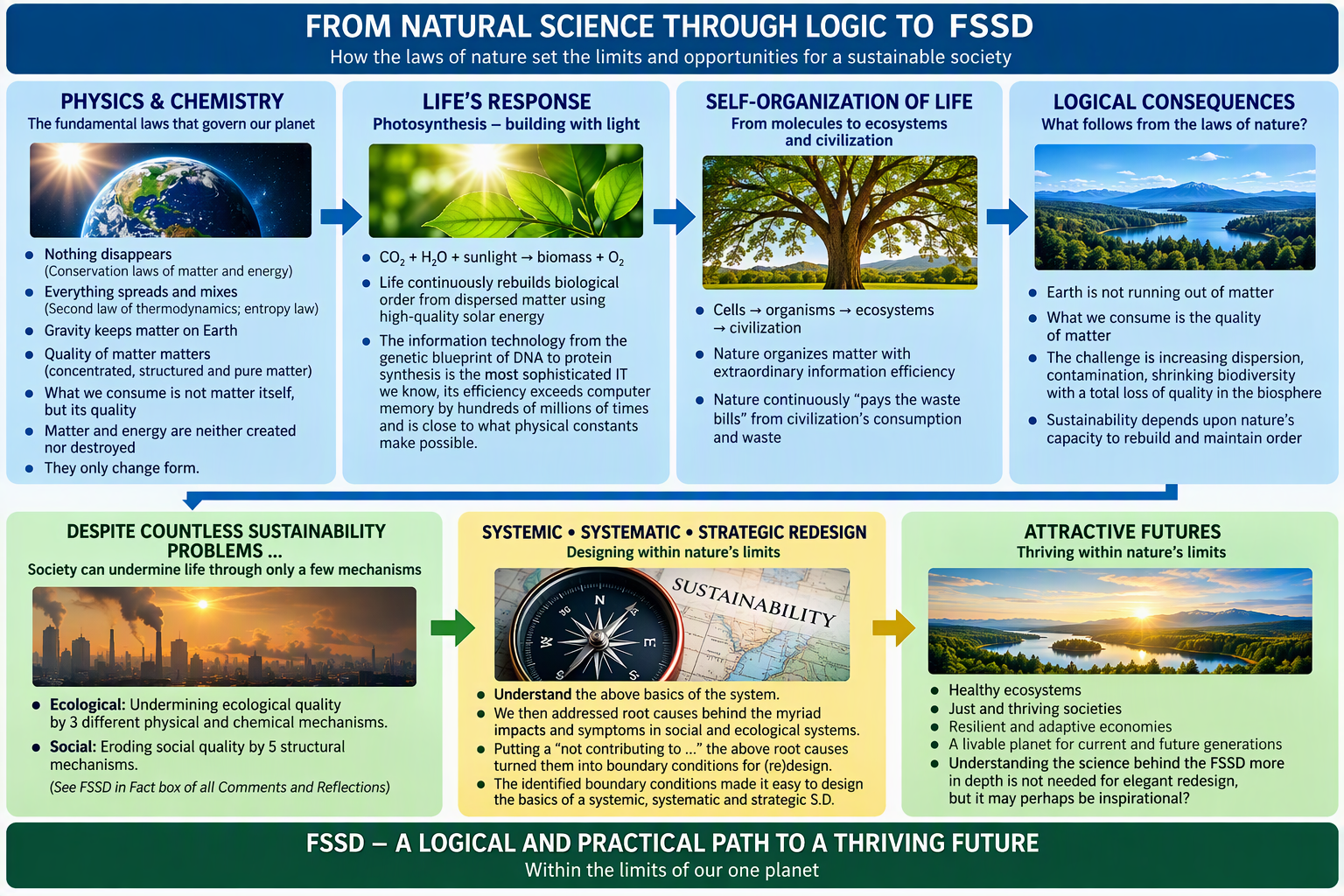
- Nothing disappears (the Conservation Laws of Matter and Energy).
- Everything spreads and mixes (the Second Law of Thermodynamics, or the Entropy Law).
- Gravity keeps the accounting honest (matter dispersed on Earth remains on Earth).
- Quality matters (concentrated, structured and pure matter, together with available exergy).
- What we consume is quality of matter, not matter itself.
- Photosynthesis continuously rebuilds quality (paying the bills for the consumption of quality).
So how can civilization undermine Nature’s order? Surprisingly, only through a few fundamental mechanisms. Hence the boundary conditions for (re)design within the FSSD.
And by the way, the biosphere is the most sophisticated information-processing system we know. Perhaps that insight can deepen both our respect and our care for Nature.
Most discussions about sustainability start at the wrong end. They begin with climate change, biodiversity loss, pollution, social inequality, resource scarcity, or some other visible symptom. Yet symptoms rarely explain themselves.
To understand why societies repeatedly create such problems, the development of the FSSD began by asking a more fundamental question:
What are the laws of nature that frame all societies, economies and technologies?
The answer was remarkably simple, as illustrated in the figure above and the bullet list beneath it.
From these fundamentals follows an insight that is surprisingly absent from most sustainability discussions:
What we consume is not matter itself. What we consume is the quality of matter.
When food becomes body waste, when a concentrated ore becomes dispersed materials, or when pure substances become contaminated mixtures, the matter remains. What disappears is quality, expressed as concentration, structure and purity.
The quantity remains.
The quality does not.
This means that sustainability is a matter of matter. The quality of it, expressed as concentration, structure and purity.
Even when discussing energy systems, the sustainability challenges ultimately concern matter: emissions, pollutants, degraded ecosystems, depleted soils, and countless forms of increasing dispersion and impurity from fuel-based energy systems.
Our planet contains a process capable of running in the opposite direction, creating quality back from matter having lost its quality. For billions of years, life has continuously evolved from this process.
The chemistry behind this extraordinary accomplishment is based on photosynthesis “building with light”, a first-step process performed by plant cells:
Carbon dioxide + Water + Sunlight → Sugar + Oxygen
The by-product of this first step in sugar production is oxygen, released to the atmosphere. Animals then run the process in reverse through respiration, using oxygen and sugar to release the energy required for movement while returning water vapor and carbon dioxide to the cycle.
Using solar energy, dispersed substances are transformed, through the cycles of Nature, into forests, grasslands, coral reefs, food webs, and eventually civilizations.
But chemistry alone is not enough to explain this remarkably sophisticated result. The organization of matter also requires information.
Life employs a level of information efficiency that remains astonishing. From DNA to proteins, cells, organisms and ecosystems, Nature continuously organizes matter into increasingly sophisticated structures. The biosphere is the most advanced information-processing system we know, operating remarkably close to the limits set by the physical constants – what is basically and theoretically possible.
Acknowledging this was not an essential part of designing the FSSD. Yet the humbling effect may also be a way of encouraging greater compassion and care for our planet.
Some substances are acutely toxic and therefore easy to recognize as dangerous. Others appear relatively harmless but persist for decades, centuries, or longer. Still others are entirely novel to the biosphere. Where the safe thresholds for thousands of chemicals are is impossible to determine until they have already been crossed. The only conclusion is to use the FSSD’s boundary conditions to put an absolute halt to systematically increasing concentrations of all chemicals.
The challenge is therefore not merely to identify “dangerous chemicals.” All substances become deleterious above certain thresholds. Sustainable redesign therefore means halting systematically increasing concentrations of all substances, while also ending the physical degradation of the Sun-driven biosphere with its biodiversity, the great “quality machine” for handling waste molecules in the first place.
We routinely expose this quality machine, with its information system incomparably more sophisticated than any computer we have ever built, to systematically increasing waste molecules and physical alterations it has never previously encountered.
And this is precisely what drove our development of the FSSD: to apply science upstream in cause-effect chains and identify a few fundamental flaws of design. All in order to avoid the impossible task of chasing myriad deleterious symptoms after they emerge. The goal was to provide a practical and manageable framework for systemic (world), systematic (stepwise), and strategic (economical) development.
You do not need physics and chemistry to become a Master of Strategic Sustainable Development. The FSSD and its ABCD methodology were designed precisely so that you do not have to. But a brief look behind the curtain may still be worthwhile.
Understanding a little more about the science can strengthen confidence in the framework, deepen engagement in the art of strategic redesign, and perhaps inspire a little additional curiosity about the remarkable planet we are attempting to sustain.
After all, any coherent worldview, including our understanding of sustainability, begins with physics and chemistry.
Karl-Henrik Robèrt
Professor
Blekinge Institute of Technology
Campus Gräsvik,Valhallavägen 1
SE-371 79 Karlskrona, Sweden
Phone: +46 455385000
Blekinge Institute of Technology helps you take strategic steps toward sustainability!
Research for Real Change | Training for Leaders | Coaching for Role Models | A Movement for Change