Kalle and Dr. Lisa Wälitalo reflect on ABCD implementation across departments, sectors and wider stakeholder groups
Key takeaway for leaders, facilitators, and co‑creators
Previous Reflections on ABCD planning have covered systems thinking, design science, and the psychology of moderating ABCD workshops, and all topical ‘Kalle Reflecs’ rest on the same scientific foundations.
This Reflection highlights how ABCD competence and mindset can be implemented across sectors, value chains, and broader cooperative stakeholder groups. The emerging implementation model builds on spontaneously occurring large‑scale cooperative projects made possible by the FSSD’s Operative System, as illustrated in earlier Reflections from the Polymer and Traffic sectors.
Here, these experiences are combined with prospective studies synthesized in Dr. Lisa Wälitalo’s PhD work, exploring how cross‑sector cooperation improves when the Operative System plus its validated implementation model are clarified upfront. The Åland case, summarized in an action‑research paper, offers an ideal illustration of iterative cycles of widening stakeholder collaboration grounded in the ABCD‑based Operative System [1]. One overriding challenge for long-term success is to have top managements and owners be active part of the co-creation.
This Reflection highlights how ABCD competence and mindset can be implemented across sectors, value chains, and broader cooperative stakeholder groups. The emerging implementation model builds on spontaneously occurring large‑scale cooperative projects made possible by the FSSD’s Operative System, as illustrated in earlier Reflections from the Polymer and Traffic sectors.
Here, these experiences are combined with prospective studies synthesized in Dr. Lisa Wälitalo’s PhD work, exploring how cross‑sector cooperation improves when the Operative System plus its validated implementation model are clarified upfront. The Åland case, summarized in an action‑research paper, offers an ideal illustration of iterative cycles of widening stakeholder collaboration grounded in the ABCD‑based Operative System [1]. One overriding challenge for long-term success is to have top managements and owners be active part of the co-creation.
More in detail
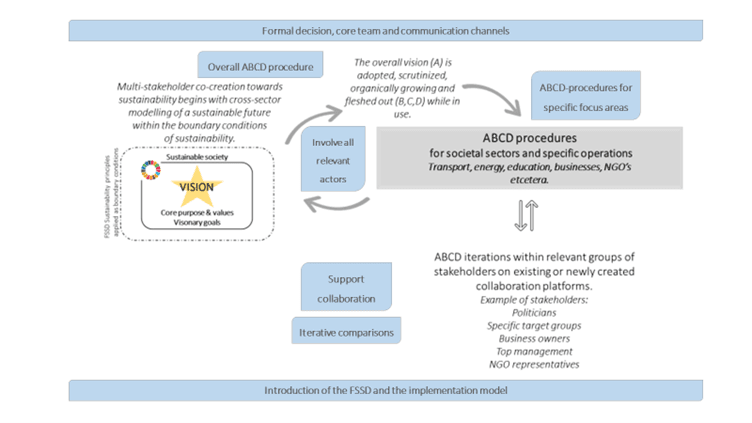
The illustration shows how partners across sectors, organizations, and disciplines cocreate a shared vision within the boundary conditions (A) and gradually refine it through iterative ABCD workshops. Already during workshop preparation it is helpful to consider at least basic know-how from various sectors such as energy, engineering, spatial planning, and political science. The process may also involve more specific ABCD workshops amongst experts from such sectors, in between the larger assemblies. The results from such are synthesized and brought into the broader stakeholder setting to update and strengthen the shared vision through the ABCD framework. The cycles then repeat.
Although the typical starting point is ABCD work revolving around a shared vision in a larger group, the approach can just as well begin with smaller specific ABCD procedures amongst more specialized groups. The emerging smaller scopes often expand naturally as participants recognize the need for a joint vision across wider stakeholder groups. For example, a proposal on the C‑list may be feasible only if other actors are included. This creates momentum, shared purpose, and co‑creation for broader systemic solutions, such as in Product‑Service Systems or moving from municipal to regional, national or international collaboration.
Challenges
Introducing new people
Positive outcomes rely on the management of some challenges highlighted in the paper. One such challenge is the continuous onboarding of new participants—an inevitable feature of long‑term collaborative work. This requires sustained education, training, and capacity‑building, in addition to the iterative ABCD workshops themselves. As in sports, training and practice between “matches” are essential.
Top management must be actively involved
Another recurring challenge observed in follow‑ups across organizations and regions is not merely securing top‑management support but ensures their active participation in ABCD workshops. This need not occur at every workshop but should take place periodically, for example when reporting results. Such engagement (i) reinforces the strength and effectiveness of systemic, systematic, and strategic cooperative development, and (ii) naturally inspires future planning with adequate time, financial resources, and staffing allocated to sustain expanding and effective ABCD processes. If we are to determine the most common, yet serious challenge, this would be the one. Haste amongst top managements threatens reflection at a particularly dangerous level.
This aligns well with the traditional Deming cycle. Without ongoing engagement from top management and owners, the continuation of ABCD thinking is demonstrably at risk.
Additional conditions for continuity
Beyond continuous capacity‑building and active leadership, several further conditions for continuity emerged from follow‑up studies, including the Åland case (see also reference below [2]. In short, success depends on a mindset of conscious awareness throughout the implementation process, of the following topics:
(i) learning by doing, get going in real-life changes as soon as the basics are shared.
(i) learning by doing, get going in real-life changes as soon as the basics are shared.
(ii) build on current possibilities and potential,
(iii) boldness in challenging existing structures and routines,
(iv) clear and consistent communication,
(v) inclusive sharing of responsibilities, and
(vi) dissemination of practical examples of ABCD workshops wherever possible.
(iv) clear and consistent communication,
(v) inclusive sharing of responsibilities, and
(vi) dissemination of practical examples of ABCD workshops wherever possible.
Conclusion
ABCD workshops function as recurring cycles where diverse actors cocreate and iteratively refine a shared vision within the scientifically defined boundary conditions of the Operative System. Each cycle can be deepened through sector‑specific or discipline‑specific ABCD sessions, which may surface new strategic opportunities and challenges for the whole stakeholder group. Success depends on continuously onboarding and training new participants, and on active engagement from top management at key points where direction and resources are set for new rounds of co‑creation. When these and related conditions are met, the ABCD approach becomes a scalable and effective model for coordinated strategic development across organizations and sectors. A good read is also the Kalle Reflection on how to moderate ABCD workshops while avoiding obsolete meeting methods that are a waste of time.
[1] 28th International Sustainable Development Research Society Conference, Stockholm, 15-17 June 2022 www.diva-portal.org/smash/get/diva2:1741631/FULLTEXT01.pdf
[2] Wälitalo, L., Callaghan, E., Robèrt, K.-H., & Broman, G. (2026). How to enhance continuity of strategic sustainable development work in municipalities and regions – findings from Sweden and Finland. Earth System Governance, 27, 100307. https://doi.org/10.1016/j.esg.2025.100307
Karl-Henrik Robèrt
Professor
Blekinge Institute of Technology
Campus Gräsvik,Valhallavägen 1
SE-371 79 Karlskrona, Sweden
Phone: +46 455385000
Blekinge Institute of Technology helps you take strategic steps toward sustainability!
Research for Real Change | Training for Leaders | Coaching for Role Models | A Movement for Change