Kalle Comments on the Special Challenges of the Financial industry – As well as promising opportunities for its role in attractive scalable futures –
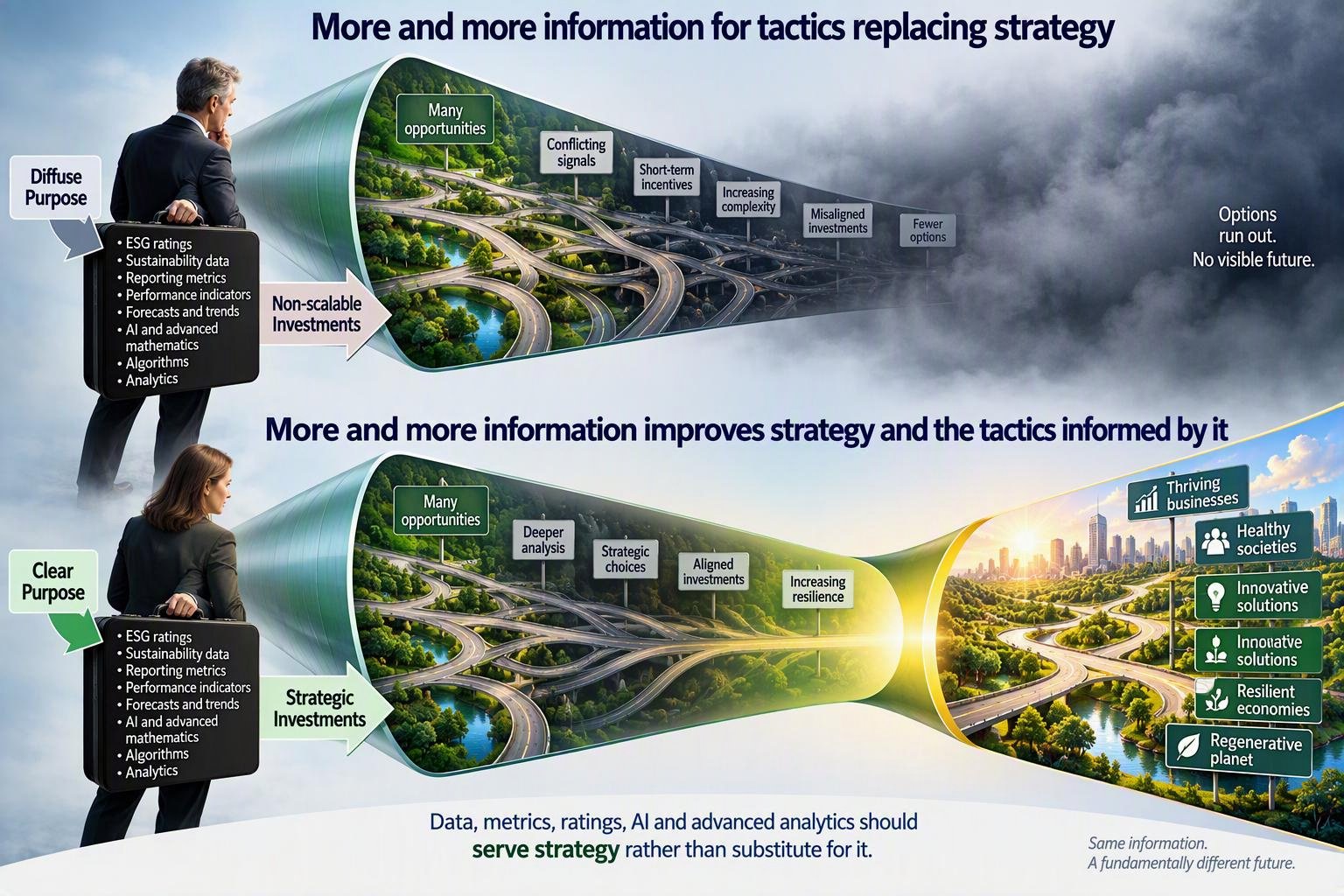
Figure: The same information. A fundamentally different future. The tiny difference is the term “Clear Purpose” pointing into the black portfolio of the strategist https://fssd.global/kalle-reflects/kalle-reflects-on-design-science-developed-as-system-dynamics-guided-by-purpose/. It is the most commonly yet dangerously missed piece of sustainable development. Besides this, investors draw upon identical sources of information and analytical sophistication. In the upper funnel, information increasingly serves tactical optimization without a clear and robust strategic orientation, leading to diminishing optionality and the gradual exhaustion of viable pathways. In the lower funnel, information is guided by explicit boundary conditions for the design of sustainability/scalability, allowing non-viable pathways to be filtered out while strategically aligned options converge and ultimately expand into multiple attractive futures. The figure illustrates how information, metrics, ratings, AI and advanced analytics can either substitute for strategy or serve it.
It is now almost forty years since we first began exploring sustainability from a basic scientific perspective. We first compiled sciences of Physics, Chemistry, and Biology to create a robust World’s view on how life and biological evolution is possible on Earth. From this work we explored a new branch within Design Science, focused on defining system boundaries by purpose (see arrow entering the strategic financier’s portfolio; see URL in the figure text), not by trying to frame all details within systems. Thereby creating an operative framework that covers what is required for purpose, i.e. sustainability/scalability, at the Systemic (the whole system), Systematic (stepwise processes), and Strategic levels (improved ROI already from the start).
This framework was then tested, refined, and tested again through decades of action-research in organizations, municipalities, businesses, and university curricula across the world.
The observations summarized here draw upon that experience, including published action-research from serving as advisors and scientific board members in organizations of many kinds and scales. The purpose has consistently been to help organizations develop what we have called an “enlightened self-interest” approach to sustainability.
When viewed from this perspective, the finance industry presents both unique challenges and unique opportunities.
Since the modern sustainability movement emerged during the 1970s, corporate engagement has evolved in three broad waves. Customer-facing brands were among the first to respond to rising public concern. Their suppliers followed as procurement requirements and compliance expectations spread through supply chains. The financial sector came later. Yet finance occupies a uniquely influential position because it determines which business models gain access to capital and which do not.
This creates an interesting challenge for this particular segment of industry.
Most people would probably assume that financial institutions simply need more sustainability data, more sophisticated ratings, and more advanced analytical tools. Yet history repeatedly demonstrates that more information does not automatically lead to better decisions. In complex systems, additional information can sometimes make it harder to see what is truly important.
Organizations may become increasingly skilled at doing things better while losing sight of whether they are doing the right things. Not least, they may overlook the substantial financial advantages that can result from the latter.
Or, in other words, the challenge is not merely one of measurement. It is one of orientation and the strategic conclusions that follow from it. Only when such orientation is allowed to shape strategy can advanced analytical models and tactical tools provide their full value.
In a more thorough Reflection on this topic, the following conclusions are drawn.
The Special Challenge Facing Finance Institutions
Most organizations can develop direct operational experience of sustainability challenges within their own businesses. Financial institutions, however, must evaluate, compare, and allocate capital among large numbers of organizations operating across diverse sectors and markets.
This places them at greater distance from the day-to-day activities they seek to evaluate.
As a result, financial institutions depend heavily upon external information sources, ratings providers, research firms, consultants, and data vendors. This creates a particular challenge: the quality of investment decisions depends heavily on the quality of information entering the system. Advanced algorithms and mathematical models cannot compensate for weak strategic assumptions. They may become black boxes of advanced tools that add complexity rather than cut strategically through it.
The Structural Dilemma
Third-party sustainability data can provide valuable tactical support for investment decisions.
However, several structural limitations follow:
- Aggregated ratings may average away critical differences in business-model design.
- Many indicators rely primarily on forecasting approaches that project historical and current trends into the future.
- Such approaches often struggle to evaluate management intent, strategic adaptability, and preparedness for fundamentally different future market conditions.
They can describe trajectories, but they are less suited to evaluating whether those trajectories move toward or away from future conditions that determine what will be scalable and successful, and what will not. Only once strategic direction has been established through science-based boundary conditions, traditional metrics and ratings remain useful. But they are then serving strategy rather than substituting for it.
- The above challenges often become more pronounced as institutions grow. Smaller investment firms can sometimes develop deeper understanding of portfolio companies while maintaining greater flexibility in capital allocation. In this regard, they may provide valuable models for improving the effectiveness of larger institutions.
To that end, we have observed many encouraging examples.
Relatively smaller and often privately owned investment firms that actively engage with portfolio companies can influence strategic direction directly. Board participation and long-term ownership positions can help integrate sustainability considerations into product development, operations, innovation, and growth strategies before costly lock-ins occur.
Similarly, banks that adopt advisory roles and help clients anticipate future market conditions can strengthen both customer relationships and the resilience of their lending portfolios.
These examples illustrate an important lesson: sustainability creates its greatest value when treated as a strategic capability rather than as a reporting exercise.
Promising Possibilities for Larger Financial Institutions
The Reflection points to several opportunities:
- Learn what modern Design Science teaches about improving investment decisions across all time scales by backcasting from attractive and scalable futures, informed by science-based boundary conditions for long-term success.
- Use this capability to strengthen strategic competence internally, while treating external ratings as valuable tactical inputs rather than substitutes for independent strategic analysis.
- Gradually develop new forms of data acquisition and analysis that are guided by these strategic incentives.
Those institutions that develop such capabilities will be better positioned to direct capital toward business models designed to prosper as ecological and social constraints become increasingly influential.
In doing so, they may help demonstrate that sustainable value creation and superior financial returns are not competing ambitions, but different expressions of the same strategic objective, both in the short and the long term.
[1] Fact Box
The FSSD operative system, “ABCD-in-the-Funnel,” is the shared foundation behind Stepwise Global, Stegvis, Kalle’s Reflections, their associated podcasts, and related applications:
Funnel
The term funnel refers to the global context within which ABCD planning takes place. Many essential ecological and social systems are currently in systematic decline and, if current trends continue, will gradually undermine society’s ability to sustain itself. Examples include forests, cropland, groundwater reserves, biodiversity, and social trust.
Boundary Conditions
The funnel opening, representing sustainability for any system, organization, product, project, or society, is operationally defined by eight boundary conditions that are robust for planning. In a sustainable society, nature is not subject to systematically increasing:
- Concentrations of substances extracted from the Earth’s crust (e.g., fossil carbon and metals).
- Concentrations of substances produced by society (e.g., naturally occurring like nitrogen oxides, or synthetic like PFAS).
- Degradation by physical means (e.g., overfishing and large-scale clear-cutting).
And, in that society, people are not exposed to structural barriers to:
- Health (e.g., unsafe working conditions).
- Influence (e.g., referendums leading to change).
- Competence (e.g., access to education and learning).
- Impartiality (e.g., fair representation in rooms of decion making).
- Meaning-making (e.g., opportunities for purpose and contribution).
ABCD
(Not an acronym, but a simple sequence of four steps: A, B, C, and D.)
A = A vision of success, framed within the eight sustainability boundary conditions.
B = An assessment of current reality, including assets and challenges in relation to that vision.
C = A broad range of possible actions that could help bridge the gap between the current situation and the desired future.
D = A prioritized strategic action plan consisting of stepwise measures selected from the C-list.
For deeper exploration, please refer to the resources listed below.
References
For further Reflections, Podcasts, Applications, and Courses, Find all of them on Stepwise Global containing a broad range of reflections, podcasts, applications, educational resources, and courses related to strategic sustainable development and the use of the FSSD. https://www.stepwise.global/
Among the reflections addressing important aspects of the methodology itself, readers may find particular value in:
- Backcasting from Principles: See figure. The conceptual foundations and scientific logic of systems thinking through a lens of purpose, of special interest for this Comment. https://fssd.global/kalle-reflects/kalle-reflects-on-backcasting-for-strategic-thinking-and-ways-of-muddying-waters/
- Latest peer-reviewed paper. This paper provides the scientific foundation of the Operative System and includes many more references to the underlying research and methodology. https://doi.org/10.1002/sd.3357
- The scientific background to the above paper, presented as an easy read of physics and chemistry https://fssd.global/kalle-reflects/kalle-reflects-on-how-the-laws-of-nature-underpin-the-logic-of-the-operative-system/
- The psychology of ABCD Workshops: how the methodology is applied in practice and how group dynamics influence outcomes. https://fssd.global/kalle-reflects/kalle-reflects-on-the-psychology-of-abcd-in-funnel-workshops/
- An Attractive Sustainable World (Step A): Because every system is nested within the larger global system, a model of a sustainable world within the boundary conditions determines the ultimate scalability of any specific organization, project, region, product, or other topic. https://fssd.global/kalle-reflects/kalle-reflects-in-concrete-terms-on-an-attractive-sustainable-world-at-a/
- The C-list of ABCD planning: If the C-list is too thin or superficial, you run into the classic “poor data in, poor results out” problem when you use the Operative System.
- The overriding success factor: when leaders are actively involved in intellectual performance https://fssd.global/kalle-reflects/kalle-reflects-on-success-and-failure-respectively-from-the-operative-systemabcd-in-funnel/
- Economic growth: An overview of the current mis-informed discussion on economic growth, outlining two ditches as well as the high-road between them. https://fssd.global/kalle-reflects/kalle-comments-on-four-headed-elephant-in-the-economic-room/
- The Plato cave and the psychological resistance amongst economists to take part in the development of a smarter economy, taking the above reflection seriously. https://fssd.global/kalle-reflects/kalle-reflects-on-the-plato-cave/
- Reporting aligned with the FSSD: The typical lack of “strategic indicators” makes reporting meaningsless. https://fssd.global/kalle-reflects/kalle-comments-on-eu-directives-for-sustainability-reporting/
- Ethics vs. criminals gaining from FSSD thinking, Enlightened self interest https://fssd.global/kalle-reflects/kalle-reflects-on-a-new-dawn-for-oligarchs/
- FSSD planning for social sustainability. https://fssd.global/kalle-reflects/kalle-reflects-on-social-sustainability-from-boundary-conditions-to-systemic-systematic-and-strategic-progress/
- The leading global example of supply chain management in the chemical industry? https://fssd.global/kalle-reflects/reflection-on-polymers-and-their-role-in-turning-current-destruction-into-scalable-solutions-for-the-future/
These resources provide additional perspectives on the practical implementation of the Operative System and its role in strategic planning for sustainability.