Kalle Comments on Design Science developed as System Dynamics guided by Purpose
Figure
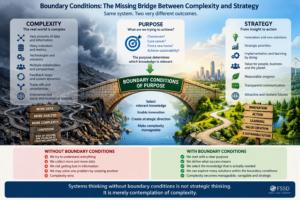
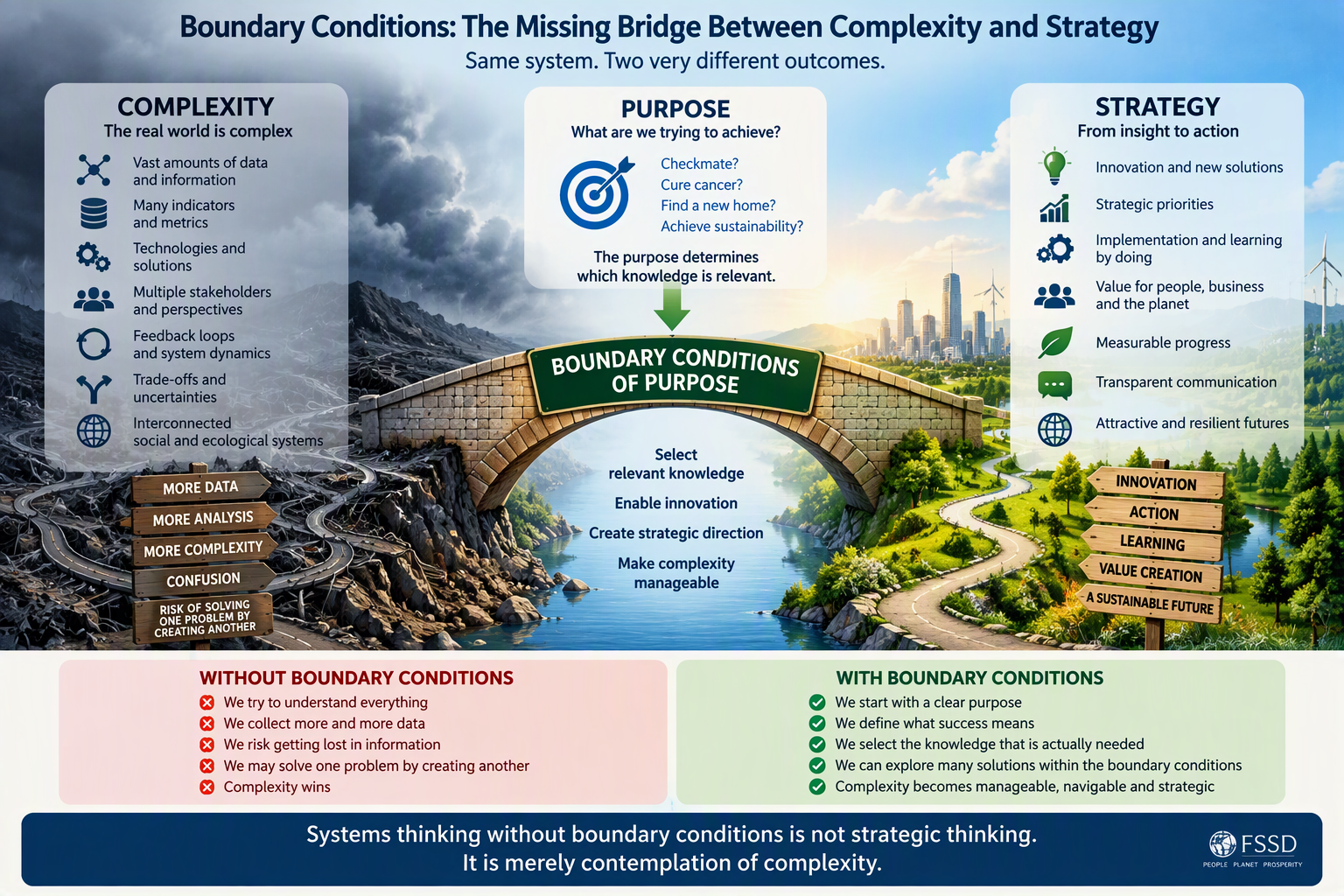
The first scientific layer needed for the development of FSSD: Design Science developed as systems dynamics guided by purpose.
(Next weekend we turn to the deeper, ultimate scientific layer, upon which Design Science rests; Physics and Chemistry.)
Informing complex missions in complex systems through boundary conditions for successful outcomes opens the door to genuine “out-of-the-box” thinking. You are then not a slave of “improving” what is already there but can creatively produce truly new scalable innovations towards attractive goal(s).
However, being crystal clear about the boundary conditions for purpose should not include attempts to tamper with the myriad possible scenario details within such boundary conditions. We leave this with our clients, who only get support to reach their dreamed-of contents within the boundary conditions. This appeals to strategic learning by doing, feels psychologically inclusive rather than prescriptive, invites communities, regions and value chains to co-create attractive scenarios within the boundary conditions, and is easier. It is more fun too.
The terms systems thinking, systemic, holistic, and system dynamics have become increasingly popular. Yet they often leave people with the impression that solving complex problems requires understanding everything about complex systems.
Nobody can do that.
Nor is it necessary.
The key is not comprehensive knowledge of every detail. Nor has it got anything to do with the size of the system. The key is clarity about the boundary conditions of the purpose you seek to achieve.
Consider an atom.
An atom is a cosmos of relationships between matter and energy. Yet no physicist attempts to understand everything about an atom before taking action. Instead, the physicist first clarifies the purpose.
Do we want to split the atom? Fuse it? Combine it into a molecule? Discover a new particle? Other?
The answer, expressed as robust boundary conditions for the project’s design, determines how to select and structure the relevant knowledge for the purpose.
The same principle applies to chess. The number of possible board positions is astronomical. Yet skilled chess players do not attempt to analyze every possibility. They continuously work within the four relatively simple boundary conditions that define checkmate. Randomly moving pieces according to the rules would not appeal to many. Playing with the boundary conditions for checkmate in mind is where the real thrill and the joy of learning lie.
This may all sound obvious, but its implications are profound.
- Without boundary conditions, complexity becomes overwhelming. We drown in data, collect information for its own sake, and risk solving one problem by creating another.
- With boundary conditions, the opposite happens. Complexity becomes manageable. We can systematically select the information required for the mission at hand. Yes, even the exclusion of data that is irrelevant to the purpose can enhance learning from the larger system.
In fact, people use this approach naturally every day. Imagine moving to a new city because of a new job. Finding a suitable home is a complex challenge involving countless variables. Yet most people navigate it remarkably well.
Why?
Because they work within only four boundary conditions.
- The home must be available on the market.
- It must be affordable.
- It must allow reasonable commuting.
- It must function for the family in the geographic region.
Within those boundary conditions, options are explored, compared, and improved until suitable options for the new home emerge.
Nobody tries to evaluate every possible house in existence.
We instinctively model alternatives against boundary conditions.
Ironically, humanity often abandons this common-sense approach when confronting sustainability.
Instead of asking what boundary conditions a sustainable society must satisfy, discussions frequently become trapped in endless debates about individual issues, values, indicators, technologies, targets, and competing priorities.
Yet sustainable development is also a complex goal in a complex system.
Like every other such challenge, it requires boundary conditions robust for planning, action and communication.
This development of Systems Dynamics was necessary for the breakthrough of the Framework for Strategic Sustainable Development (FSSD). The FSSD approach is to identify the fundamental mechanisms through which human activities systematically undermine ecological and social systems. The sustainability principles were then formulated as boundary conditions that prevent these mechanisms, essentially by placing a “not” in front of them. This opens up a vast space for innovation, allowing the design of future scenarios that do not contribute to any of these mechanisms.
Once such boundary conditions are established, innovation flourishes.
Any future can be explored.
Any technology can be considered.
Any business model can compete.
The only requirement is that proposed solutions, with the data relevant for them, comply with the boundary conditions.
This distinction matters for leaders.
Many organisations invest substantial resources in sustainability initiatives, assessment tools, reporting systems, certification schemes, and other forms of decision support.
These tools can be highly valuable.
But they are applications, Apps.
Before selecting applications, leaders need an Operative System capable of creating coherence among them by clarifying how each relates to the full systemic perspective, and thereby to one another. Only then is it possible to select the applications most helpful for the specific destination and the journey.
The ultimate lesson is therefore surprisingly simple.
Systems thinking is not about trying to understand everything.
It is about understanding enough of a system to move purposefully toward a goal defined by boundary conditions that are robust for your purpose or mission.
–Without them, complexity wins.
-With them, complexity becomes manageable, navigable, measurable, and possible to calculate, monitor and communicate clearly.
So, Systems thinking without boundary conditions is not strategic thinking. It is merely contemplation of complexity.
Things covered in the corresponding full Reflection are found at https://fssd.global/kalle-reflects/is-systems-thinking-helpful-for-strategic-sustainable-development-yes-on-one-condition/ It is structured like this:
- Boundary Conditions as the Missing Key to Systems Thinking
- The Strategic Difference Between an Operative System and Decision-Support Apps
- Why Sustainability Needs an Operative System Before Apps
- The Surprising Psychology of Negative Boundary Conditions
- How People Already Think Systemically in Everyday Life
- Why scientists within special fields are not trained to apply this intuitive knowledge.
[1] Fact Box
The FSSD operative system, “ABCD-in-the-Funnel,” is the shared foundation behind Stepwise Global, Stegvis, Kalle’s Reflections, their associated podcasts, and related applications:
Funnel
The term funnel refers to the global context within which ABCD planning takes place. Many essential ecological and social systems are currently in systematic decline and, if current trends continue, will gradually undermine society’s ability to sustain itself. Examples include forests, cropland, groundwater reserves, biodiversity, and social trust.
Boundary Conditions
The funnel opening, representing sustainability for any system, organization, product, project, or society, is operationally defined by eight boundary conditions that are robust for planning. In a sustainable society, nature is not subject to systematically increasing:
- Concentrations of substances extracted from the Earth’s crust (e.g., fossil carbon and metals).
- Concentrations of substances produced by society (e.g., naturally occurring like nitrogen oxides, or synthetic like PFAS).
- Degradation by physical means (e.g., overfishing and large-scale clear-cutting).
And, in that society, people are not exposed to structural barriers to:
- Health (e.g., unsafe working conditions).
- Influence (e.g., referendums leading to change).
- Competence (e.g., access to education and learning).
- Impartiality (e.g., fair representation in rooms of decion making).
- Meaning-making (e.g., opportunities for purpose and contribution).
ABCD
(Not an acronym, but a simple sequence of four steps: A, B, C, and D.)
A = A vision of success, framed within the eight sustainability boundary conditions.
B = An assessment of current reality, including assets and challenges in relation to that vision.
C = A broad range of possible actions that could help bridge the gap between the current situation and the desired future.
D = A prioritized strategic action plan consisting of stepwise measures selected from the C-list.
For deeper exploration, please refer to the resources listed below.
References
For further Reflections, Podcasts, Applications, and Courses, Find all of them on Stepwise Global containing a broad range of reflections, podcasts, applications, educational resources, and courses related to strategic sustainable development and the use of the FSSD. https://www.stepwise.global/
Among the reflections addressing important aspects of the methodology itself, readers may find particular value in:
- Latest peer-reviewed paper. This paper provides the scientific foundation of the Operative System and includes many more references to the underlying research and methodology. https://doi.org/10.1002/sd.3357
- The scientific background to the above paper, presented as an easy read of physics and chemistry https://fssd.global/kalle-reflects/kalle-reflects-on-how-the-laws-of-nature-underpin-the-logic-of-the-operative-system/
- Backcasting from Principles: the conceptual foundations and scientific logic of systems thinking through a lens of purpose. https://fssd.global/kalle-reflects/kalle-reflects-on-backcasting-for-strategic-thinking-and-ways-of-muddying-waters/
- The psychology of ABCD Workshops: how the methodology is applied in practice and how group dynamics influence outcomes. https://fssd.global/kalle-reflects/kalle-reflects-on-the-psychology-of-abcd-in-funnel-workshops/
- An Attractive Sustainable World (Step A): Because every system is nested within the larger global system, a model of a sustainable world within the boundary conditions determines the ultimate scalability of any specific organization, project, region, product, or other topic. https://fssd.global/kalle-reflects/kalle-reflects-in-concrete-terms-on-an-attractive-sustainable-world-at-a/
- The C-list of ABCD planning: If the C-list is too thin or superficial, you run into the classic “poor data in, poor results out” problem when you use the Operative System.
- The overriding success factor: when leaders are actively involved in intellectual performance https://fssd.global/kalle-reflects/kalle-reflects-on-success-and-failure-respectively-from-the-operative-systemabcd-in-funnel/
- Economic growth: An overview of the current mis-informed discussion on economic growth, outlining two ditches as well as the high-road between them. https://fssd.global/kalle-reflects/kalle-comments-on-four-headed-elephant-in-the-economic-room/
- The Plato cave and the psychological resistance amongst economists to take part in the development of a smarter economy, taking the above reflection seriously. https://fssd.global/kalle-reflects/kalle-reflects-on-the-plato-cave/
- Reporting aligned with the FSSD: The typical lack of “strategic indicators” makes reporting meaningsless. https://fssd.global/kalle-reflects/kalle-comments-on-eu-directives-for-sustainability-reporting/
- Ethics vs. criminals gaining from FSSD thinking, Enlightened self interest https://fssd.global/kalle-reflects/kalle-reflects-on-a-new-dawn-for-oligarchs/
- FSSD planning for social sustainability. https://fssd.global/kalle-reflects/kalle-reflects-on-social-sustainability-from-boundary-conditions-to-systemic-systematic-and-strategic-progress/
- The leading global example of supply chain management in the chemical industry? https://fssd.global/kalle-reflects/reflection-on-polymers-and-their-role-in-turning-current-destruction-into-scalable-solutions-for-the-future/
These resources provide additional perspectives on the practical implementation of the Operative System and its role in strategic planning for sustainability.