Kalle Comments on Fusion Power
Public discussions about fusion power are often dominated by questions of scientific and engineering feasibility.
Those questions can be organized in a logical chain of dependencies:
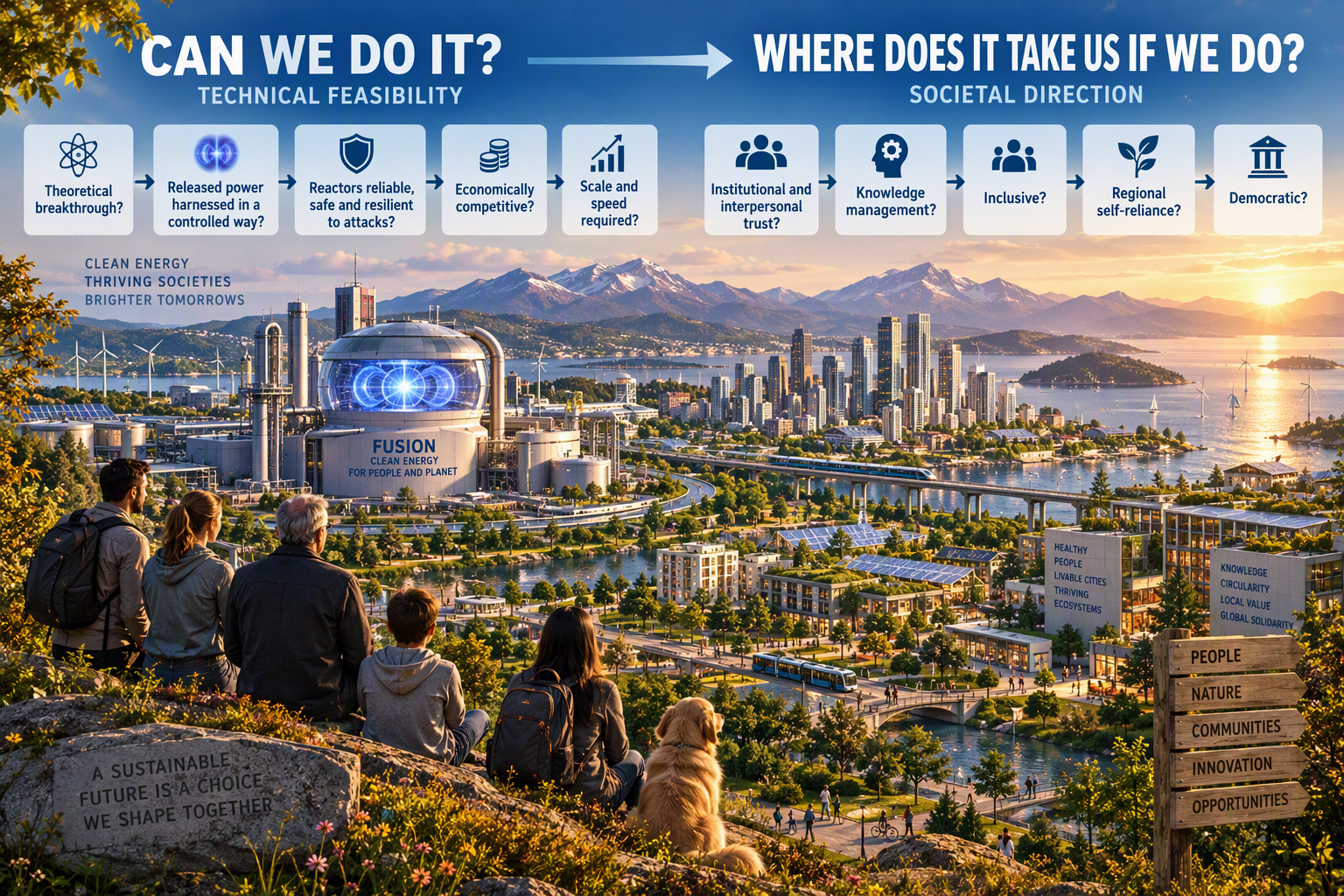
Can the immense energy released when hydrogen nuclei fuse be harnessed in a controlled way rather than in the form witnessed in hydrogen bombs?
If so,
Can fusion reactors be made sufficiently reliable and safe? If so,
Can they become economically competitive? If so,
Can they be deployed at the scale and speed required to address humanity’s growing energy challenges and sustainability concerns?
These are legitimate questions. Indeed, positive answers to all of them would be prerequisites for any rational discussion about fusion as a significant contributor to society’s future energy supply.
Yet they share a common underlying assumption: that the direction itself has already been chosen.
Strategic Sustainable Development invites a prior question.
Before asking whether a particular technology can be optimized, we might first ask whether it stands a realistic chance of moving society rapidly in the right direction, and in a way competitive with alternatives.
Most fusion debates concern uncertainties within a predetermined constraint frame of physics and engineering. They explore costs, timelines, materials, safety, performance, and technical feasibility. Important as these considerations may be, they differ from
asking whether increasing society’s dependence on highly centralized, complex and technologically sophisticated energy systems is itself a strategically preferable direction.
This distinction resembles one explored in discussions around nuclear power. Debates often become occupied with risks, improvements, and technical solutions within an assumed trajectory, while overlooking the more fundamental question of whether the trajectory
itself is competitive with scalable alternatives already available and being deployed today.
Meanwhile, the fusion reactor upon which all life already depends has operated uninterrupted for billions of years. The Sun delivers immense quantities of energy through natural flows that can be harvested directly through technologies already available today.
For leaders, this shifts the conversation. Leadership is rarely about maximizing technological possibilities for their own sake. It is about establishing priorities under conditions of limited resources, limited time, and growing urgency.
Fusion may eventually succeed. It may even lead to some fusion reactors on Earth in the longer term. Yet the strategic question remains unchanged.
Would a future theoretical breakthrough for controlled fusion on Earh stand a chance of moving society toward sustainability more effectively and economical than expanding the capturing of eternally free energy flows already available, scalable, and aligned
with that transition?
In other words, the essential question is not simply:
Could we do it?
The essential question is:
Where does it take us if we do? To read about this more in detail, see full Reflection at fssd.global/kalle-reflects/kalle-reflects-on-nuclear-fusion-power/
[1] Fact Box
The FSSD operative system, “ABCD-in-the-Funnel,” is the shared foundation behind
Stepwise Global, Stegvis, Kalle’s Reflections, their associated
podcasts, and related applications:
Funnel
The term funnel refers to the global context within which ABCD planning takes place. Many essential ecological and social systems are currently in systematic decline and, if current trends continue, will gradually undermine society’s ability to sustain
itself. Examples include forests, cropland, groundwater reserves, biodiversity, and social trust.
Boundary Conditions
The funnel opening, representing sustainability for any system, organization, product, project, or society, is operationally defined by eight boundary conditions that are robust for planning. In a sustainable society, nature is not subject to systematically
increasing:
- Concentrations of substances extracted from the Earth’s crust (e.g., fossil carbon and metals).
- Concentrations of substances produced by society (e.g., naturally occurring like nitrogen oxides, or synthetic like PFAS).
- Degradation by physical means (e.g., overfishing and large-scale clear-cutting).
And, in that society, people are not exposed to structural barriers to:
- Health (e.g., unsafe working conditions).
- Influence (e.g., referendums leading to change).
- Competence (e.g., access to education and learning).
- Impartiality (e.g., fair representation in rooms of decion making).
- Meaning-making (e.g., opportunities for purpose and contribution).
ABCD
(Not an acronym, but a simple sequence of four steps: A, B, C, and D.)
A = A vision of success, framed within the eight sustainability boundary conditions.
B = An assessment of current reality, including assets and challenges in relation to that vision.
C = A broad range of possible actions that could help bridge the gap between the current situation and the desired future.
D = A prioritized strategic action plan consisting of stepwise measures selected from the C-list.
For deeper exploration, please refer to the resources listed below.
References
For further Reflections, Podcasts, Applications, and Courses,
Find all of them on Stepwise Global containing a broad range of reflections, podcasts, applications, educational resources, and courses related to strategic sustainable development and the use of the FSSD.
https://www.stepwise.global/
Among the reflections addressing important aspects of the methodology itself, readers may find particular value in:
- Latest peer-reviewed paper. This paper provides the scientific foundation of the Operative System and includes many more references to the underlying research and methodology. https://doi.org/10.1002/sd.3357
- The scientific background to the above paper, presented as an easy read of physics and chemistry https://fssd.global/kalle-reflects/kalle-reflects-on-how-the-laws-of-nature-underpin-the-logic-of-the-operative-system/
- Backcasting from Principles: the conceptual foundations and scientific logic of systems thinking through a lens of purpose. https://fssd.global/kalle-reflects/kalle-reflects-on-backcasting-for-strategic-thinking-and-ways-of-muddying-waters/
- The psychology of ABCD Workshops: how the methodology is applied in practice and how group dynamics influence outcomes. https://fssd.global/kalle-reflects/kalle-reflects-on-the-psychology-of-abcd-in-funnel-workshops/
- An Attractive Sustainable World (Step A): Because every system is nested within the larger global system, a model of a sustainable world within the boundary conditions determines the ultimate scalability of any specific organization, project, region, product, or other topic. https://fssd.global/kalle-reflects/kalle-reflects-in-concrete-terms-on-an-attractive-sustainable-world-at-a/
- The C-list of ABCD planning: If the C-list is too thin or superficial, you run into the classic “poor data in, poor results out” problem when you use the Operative System.
- The overriding success factor: when leaders are actively involved in intellectual performance https://fssd.global/kalle-reflects/kalle-reflects-on-success-and-failure-respectively-from-the-operative-systemabcd-in-funnel/
- Economic growth: An overview of the current mis-informed discussion on economic growth, outlining two ditches as well as the high-road between them. https://fssd.global/kalle-reflects/kalle-comments-on-four-headed-elephant-in-the-economic-room/
- The Plato cave and the psychological resistance amongst economists to take part in the development of a smarter economy, taking the above reflection seriously. https://fssd.global/kalle-reflects/kalle-reflects-on-the-plato-cave/
- Reporting aligned with the FSSD: The typical lack of “strategic indicators” makes reporting meaningsless. https://fssd.global/kalle-reflects/kalle-comments-on-eu-directives-for-sustainability-reporting/
- Ethics vs. criminals gaining from FSSD thinking, Enlightened self interest https://fssd.global/kalle-reflects/kalle-reflects-on-a-new-dawn-for-oligarchs/
- FSSD planning for social sustainability. https://fssd.global/kalle-reflects/kalle-reflects-on-social-sustainability-from-boundary-conditions-to-systemic-systematic-and-strategic-progress/
- The leading global example of supply chain management in the chemical industry? https://fssd.global/kalle-reflects/reflection-on-polymers-and-their-role-in-turning-current-destruction-into-scalable-solutions-for-the-future/
These resources provide additional perspectives on the practical implementation of the Operative System and its role in strategic planning for sustainability.