Kalle comments on silos
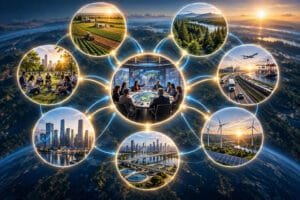
Figure: The role of the FSSD in navigating complexity.
Each societal domain contains extensive complexity and countless interrelationships. The purpose of the FSSD is to cut through complexity and provide a clear overview of those interrelationships. By filtering complexity through a common set of scientifically grounded boundary conditions for redesign, the framework enables leaders and organizations to manage complexity for coordinated progress and improved bottom lines from the outset. The result is a shared systemic competence that enables leaders to manage complexity strategically rather than be overwhelmed by the fragmented complexity of individual silos.
Public debate constantly asks us to choose priorities. Should we focus on climate change or national security? Economic growth or sustainability? Energy resilience or environmental protection? Business executives or politicians?
But what if these are the wrong questions?
Many of today’s most pressing challenges are not isolated problems competing for attention. Climate change influences resource availability. Resource pressures increase geopolitical tensions. Security concerns are shaped by energy systems and fuel dependencies. Energy systems affect economic resilience. Economic resilience influences social stability and public trust.
The connections are everywhere.
Yet our institutions remain largely organized around separate domains. Climate experts discuss climate. Military leaders discuss defense. Economists discuss growth. Politicians in democracies respond to immediate pressures and how their responses are perceived by the public. Each perspective may contain important truths. The problem is not that any of them are without value or important facts. Nor is it that their expertise would prevent them from appreciating the argument presented here. The problem is that, in isolation, none of them can adequately address challenges that emerge from the interaction among all the sectors and the problems there. Yet it is precisely this clear overview of interactions that remains least developed in practice, even among experts within each separate domain. This is particularly unfortunate because these experts represent society’s foremost competence in understanding complexity, albeit primarily within their respective fields.
Science has to go deep within specialized fields of expertise. That is both necessary and valuable. But in a complex mission within a complex system, there is also a need for a science devoted to understanding how all the sectors and problems are functionally interconnected. That is the domain of design science. Considerable progress has been made there, yet its insights are often drowned out by the louder voices emerging from the individual silos of climate, biodiversity, toxicity, economics, famine, defense, and other important sectoral concerns. Climate currently dominates much of the public conversation. Yet even climate change cannot be effectively addressed through a climate lens alone. Doing so inevitably generates new problems elsewhere, triggering legitimate systemic resistance in society.
To support such leadership, a practical planning and decision-support framework has been developed and applied across business, government, academia, and civil society: the Framework for Strategic Sustainable Development (FSSD).
This allows a different kind of leadership.
Leaders who understand the FSSD as a framework for navigating complexity across sectors are better able to:
(i) identify strategic opportunities where others see dead-end trade-offs and compromises,
(ii) connect expertise across domains to cocreate innovations around those hurdles where others see conflicting values, and
(iii) improve bottom lines where others see conflicts between ethics and business progress.
By helping leaders and experts see both the larger system and the strategic pathways for change, the framework enables more innovative decisions, stronger cooperation, and improved bottom lines from the start.
The capacity to see and manage connections between sectors and their respective challenges can be developed surprisingly quickly through a kickstart followed by continuous learning by doing.
The FSSD also increases the value of existing methods, tools, and frameworks by placing them within the broader systemic context, clearly seeing what aspects of the systemic perspective they cover.
And there has rarely been a more important time to put such leadership into practice.
For the full Reflection, please click here:
And for its podcast: https://shows.acast.com/68c6a8718b1c6a4828eaa658/6ac0e8da8da1db2e6f091a0d
Karl-Henrik Robèrt
Professor
Blekinge Institute of Technology
Campus Gräsvik,Valhallavägen 1
SE-371 79 Karlskrona, Sweden
Phone: +46 455385000
Blekinge Institute of Technology helps you take strategic steps toward sustainability!
Research for Real Change | Training for Leaders | Coaching for Role Models | A Movement for Change