Kalle reflects on the Plato Cave
This reflection follows a simple path:
The challenge → Plato’s insight → Today’s leadership dilemma → Personal lessons → Invitation through Stepwise.
The analogy of Plato’s cave is as relevant today as it was thousands of years ago.
Takeaways for Leaders at All Levels Everywhere
In my previous reflection on a “Magic Bullet for Economic Growth,” I discussed a way of conversing with a group of macroeconomists who are already contemplating more timely ways of accounting for growth, and of asking them how more macroeconomists might be drawn into this dialogue. Its theme was a very modest proposal: replacing the term Economic Growth with Desirable Economic Growth.
The reflection highlighted what the establishment, not only of macroeconomists but of leaders in many fields, would need to consider in light of the unprecedented challenges facing our world. Leaders in natural science, politics, business, and other sectors need the same thing, as well as opportunities to explore it together across expert communities. We need a balanced view on economic growth, where certain societal areas need to grow substantially, and others need to be phased out. While accounting for both.
The slow progress of macroeconomics, when judged against our current sustainability and survival challenges, is not the result of a lack of accessible and scientifically validated knowledge regarding five items:
- the Anthropocene, the new era of unprecedented human influence on Earth;
- the unprecedented challenges this era presents to leaders everywhere;
- the consequences of failing to seize the opportunity of the challenges and instead clinging to obsolete mainstream paradigms;
- the accounting for proactive action on these opportunities in economic terms;
- the strategic support to all who are seeking to lead organizations at all scales to embrace and act upon the above.
In line with the remarkable opportunities and the knowledge already available, a natural question arises:
What is stopping us?
There are many obstacles. Among them are powerful vested interests in obsolete patterns of thought and behavior. Those interests can be so substantial that their proponents continue to cling to what they own and know, thus remaining closed to new ideas. The main driver behind this is that humans, as a social species, exhibit an inherent tendency to view conformity with prevailing norms in their communities as a means of securing belonging and social acceptance.
This occurs even though points 1 to 5 offer opportunities for virtually everyone, not least through enlightened self-interest expressed as improved efficiency, reduced risk, and strong long-term performance from scalability. As discussed in an earlier Kalle Reflects, even oligarchs have reasons to benefit from such understanding.
So how do we overcome barriers that stand in the way?
This question is familiar to almost everyone who possesses a reasonable understanding of items 1 through 5 above:
How could more people be attracted to a constructive and timely dialogue on economic growth?
It is not an easy task in today’s world of haste and distraction.
Which brings us to the theme of this reflection: Plato’s Cave.
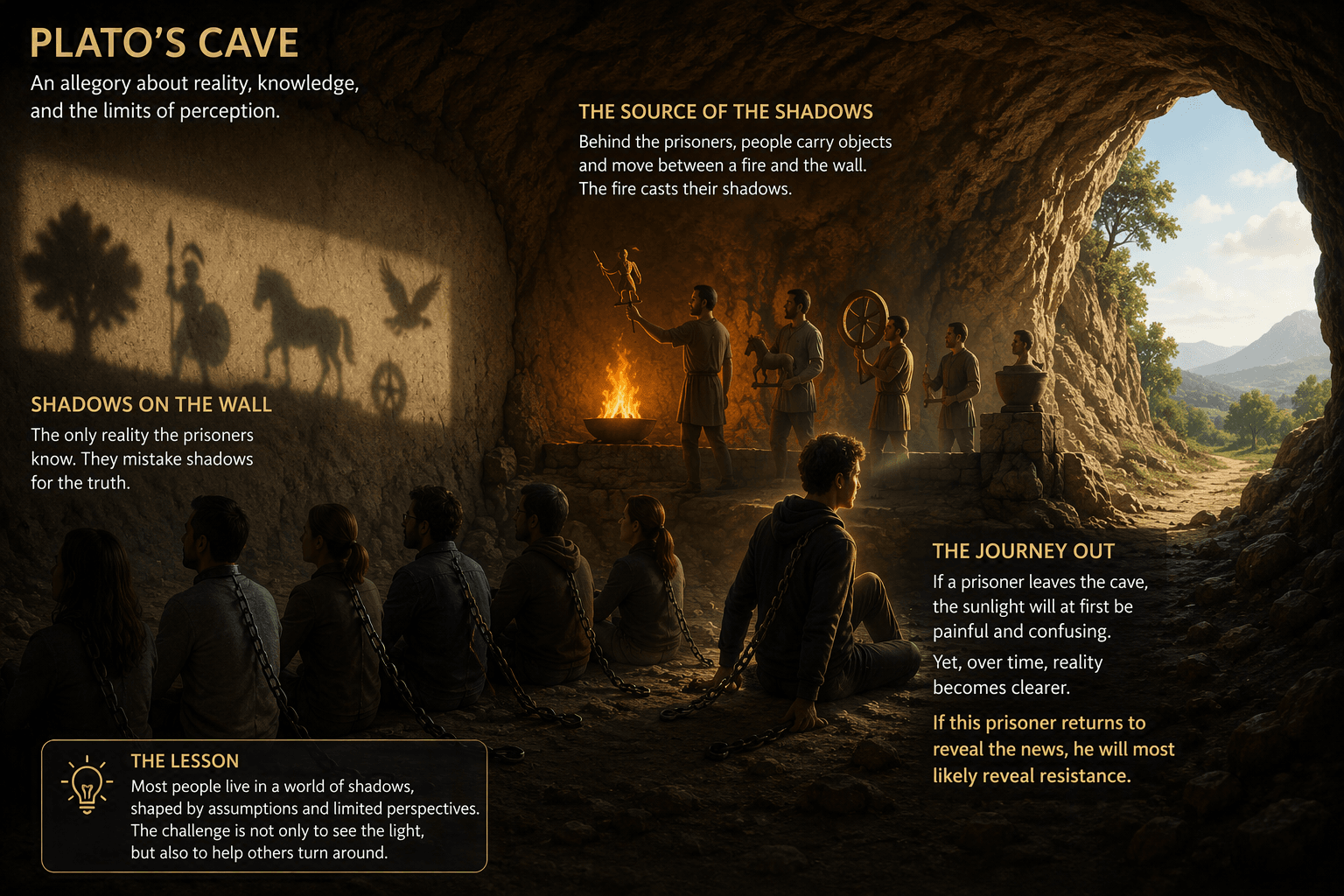
More than 2,400 years ago, Plato described how people can become trapped within a socially constructed picture of reality.
People engaged in the Framework for Strategic Sustainable Development (FSSD), that is, the science of moving from piecemeal reactions toward systemic redesign, may need only to reflect on Plato’s Cave to recognize that today’s dilemmas are far from new. Human beings have struggled for millennia with the tension between prevailing assumptions and new insight calling for systemic change.
More in detail
Here follows a brief summary from Encyclopaedia Britannica. https://www.britannica.com/topic/myth-of-the-cave :
“The myth of the cave is a famous allegory presented by the ancient Greek philosopher Plato in his work, The Republic. It illustrates Plato’s theory of Forms and his ideas about knowledge and reality. The myth describes prisoners chained in a cave, facing a wall. They can only see shadows cast on the wall by objects behind them, illuminated by a fire. These shadows are all they know of reality. If a prisoner were freed and brought outside, he or she would first be blinded by the sun but would eventually see the real world and the Forms, which are perfect, eternal essences of things. This allegory suggests that ordinary people live in a state of ignorance, perceiving mere shadows of reality. The philosopher, like the freed prisoner, ascends to a higher level of understanding by grasping the Forms, ultimately comprehending the Form of the Good.”
The relevance to today’s leadership challenges is difficult to miss.
The issue of dangerously delayed and effective responses is often not the absence of available knowledge, but rather the difficulty of leaving familiar interpretations behind and exploring alternative perspectives. In that sense, Plato’s Cave remains a remarkably modern metaphor.
Concluding Remarks
What, then, do we have here?
A double challenge for Leaders at All Levels Everywhere:
In order for all of us to learn how to explore and present robust knowledge from science we need to become better at (1) pitching scientifically robust knowledge in ways that make people choose to enter the room for dialogue in the first place and, when they get there, not disappoint them. That is, (2) presenting the knowledge in forms that are easily accessible, attractive and robust for management and utility.
Einstein expressed this as follows:
“It can scarcely be denied that the supreme goal of all theory is to make the irreducible basic elements as simple and as few as possible without having to surrender the adequate representation of a single datum of experience.”
This was later paraphrased by the composer Roger Sessions as:
“Everything should be as simple as it can be, but not simpler.”
In this forum, we respond to the outlined challenges by creating the platform
www.stepwise.global. It is designed specifically to be fit for purpose: helping to deepen awareness of the knowledge we share while making it easier to access, understand, and apply. Not least, it enables leaders in any sector to communicate and act on this knowledge while minimizing perceived threats to belonging and social acceptance. Increasingly, this includes the use of safe AI-assisted learning and training.
How can we become better at addressing the challenge posed by Plato’s Cave? Or, in the language of contemporary management education:
“How do we get people into the room?” – In this case, a room for mutual learning and sharing around Economic Growth in context of the five validated knowledge areas above
Some personal experiences from my forty years of work on this delicate arena
I would like to share a few lessons from my own forty-year journey of using science in support of strategic leadership toward scalable and attractive futures.
- I have learned, often through painful experience, how little is achieved by displaying my strong desire to teach, persuade, and promote science.
- Passion certainly matters as a personal driver, but when it has been interpreted as impatience, I have repeatedly failed.
- For me, the only reliable remedy has been to restrain my eagerness to help and the impatience that often accompanies it. Failing to do so has repeatedly created tension. In those situations, I may hear all kinds of clichés, which only fuel further impatience. By contrast, when I manage to control my impatience, the exchange usually becomes calm and productive, and I learn as much as anyone else.
Asking for advice works both ways.
It could sound like this: “You know what I want to achieve. Do you have any advice for me?”
It is a practical way of leaving impatience behind and taking a direct route to inquiry and dialogue. Over the years, asking for advice has become one of the most powerful dialogue techniques I have developed for dealing with people of my own difficult kind. So powerful, in fact, that it ought to be accompanied by ethical guidelines.
For me, it remains fascinating to see how this easy-to-remember phrase may transform the escalating heat of debate into cooperative learning. What may begin with cliché-like generalizations, such as “you always overemphasize science and dismiss what I have to say,” can evolve into the surfacing of genuinely valuable insights, such as “you forgot to consult my brother, a world-renowned expert on this very topic,” or “you talk about this change as if it were simple, but to me it is not.”
You may also notice that, over and above the bilateral learning:
- aggression, if present at the start, often disappears;
- and, by acting on the advice received, you may gain a friendly critical ally rather than an opponent.
A final confession
Do I always follow my own advice? Quite the contrary.
I repeatedly forget it and suffer the consequences.
Yet the above reflections help me examine my own failures, understand my role in them, and attempt to do a little better the next time.
The platform rests on the principle of bilateral, increasingly AI-assisted learning through dialogue. Fortunately, I am surrounded by people who are far more natural practitioners of this art than I am.
For that reason, I am grateful not to be creating the platform alone. And it keeps growing…
[1] Fact Box
The FSSD Operative System “ABCD-in-Funnel” is the shared foundation behind the organizations Stepwise Global and Stegvis, Kalle’s Reflections and their associated podcasts, and related applications.
Funnel: It refers to that the ABCD planning occurs in a global context, where all vital subsystems are gradually declining, per design, until civilization would not be able to support itself anymore; Forests, Cropland, Water-tables, Biodiversity, Social trust.
Boundary conditions: Eight hands-on conditions for operationally defining the opening of the funnel: In the sustainable society, nature is not subject to systematically increasing…
1 …concentrations of compounds from the earth’s crust, e.g. fossil coal and metals.
2 … concentrations of compounds from societal production, e.g. nitrogen oxides and CFCs..
3 …degradation by physical means, e.g. overfishing and large clear-cuts.
felt as self-evident as gravity.”
…and in that society, people are not exposed to structural barriers to
4. health (e.g. working conditions),
5. influence (e.g. polls),
6. competence (e.g. education programs),
7. impartiality (e.g. composition of boards) and
8. meaning-making (e.g. purposeful missions).
ABCD:
A = Desired future state, modelled within the eight boundary conditions for sustainability.
B = Current reality in relation to A, revealing the gap between present conditions and the desired future.
C = Brainstormed actions capable of bridging that gap.
D = A strategically prioritized action plan derived from the C-list.
For deeper exploration, please refer to the resources listed below.
References
Operative System for Strategic Sustainable Development—Coordinating Analysis, Planning, Action, and Use of Supports Such as the Sustainable Development Goals, Planetary Boundaries, Circular Economy, and Science‐Based Targets” published in Sustainable Development (Volume 33, Issue 4, pages 4759–4774)
For more Reflections, Podcasts, Applications and Courses in general – for learning and training of the Operative System.
www.stepwise.global/ Related Reflections of relevance for this particular one on Growth (e.g. for the Reflection on Growth below)
- The four-headed Elephant in the Economic room (first choice for this reflection).
- Erosion of Terms Behind Unclarity of Minds
- Karin Pettersson’s bok on Zombie Capitalism, “Förbannelsen” (“The Curse”)
- Backcasting for Strategic Thinking and Ways of Muddying Waters
- Low Consumption Society: Risky Myth vs. Solutions
- An Attractive Sustainable World at A
- ABCD Workshops and Their Psychology