- A Reflection on an Idea that may arguably be all we need for Economic Growth: Simply Change the Term to Desirable Economic Growth –
A Lens Through Which to Read This Reflection
- A change in terminology may be all it takes.
- Everyone intuitively understands that desirable things should grow.
- Everyone intuitively understands that undesirable things should be phased out.
- The term invites inquiry rather than prescription.
- The resulting dialogue encourages learning rather than ideological positioning.
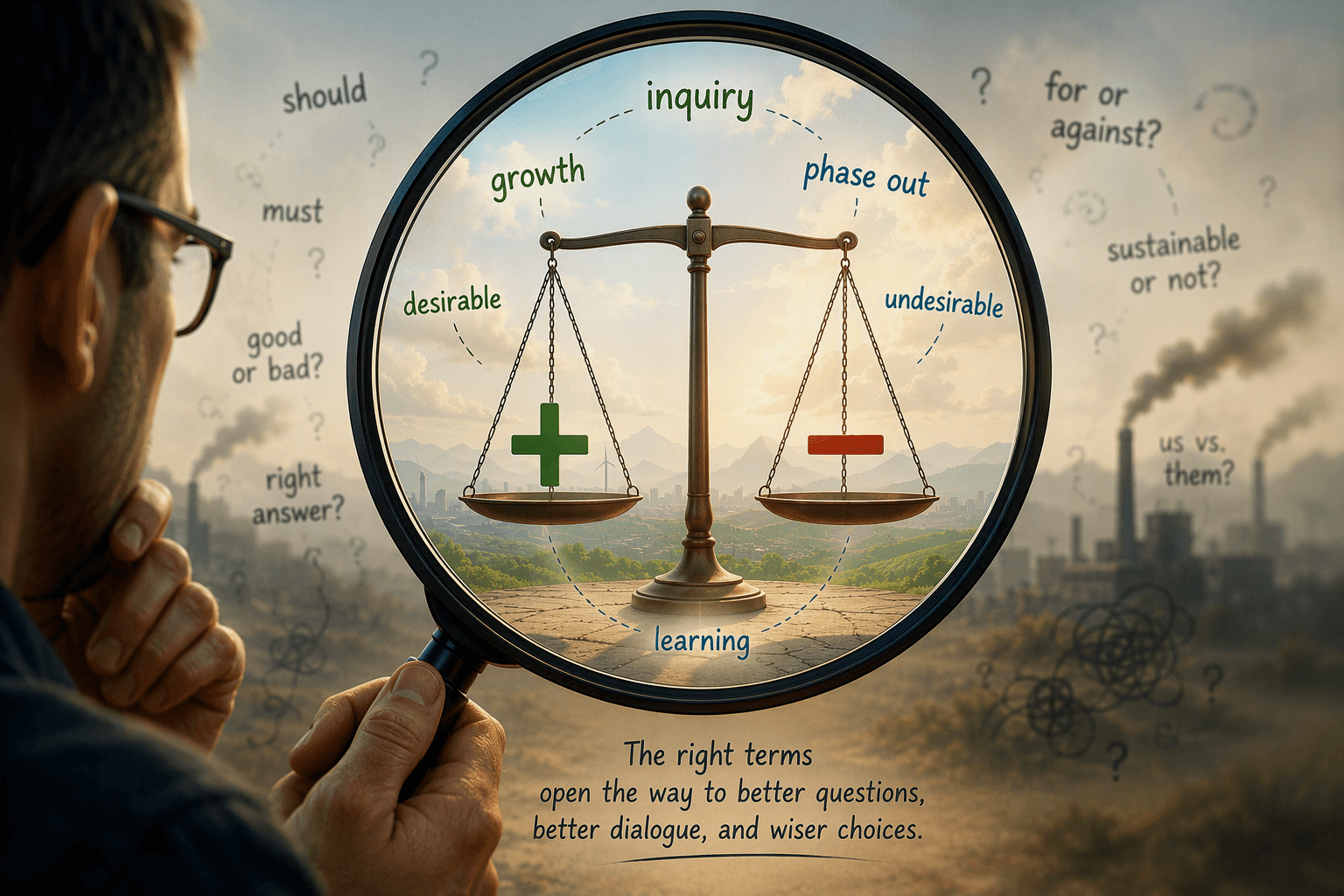
A minor shift in the terminology of growth may be all it takes. Most people intuitively understand that desirable activities should grow (+) and that undesirable activities should be phased out (−). Framing the discussion in these terms invites inquiry rather than prescription and encourages learning rather than ideological positioning.
Takeaway for Leaders at All Levels
Economic growth is not the problem. Growth of the wrong things is.
What if leaders simply began speaking of ‘desirable economic growth’ rather than ‘economic growth’? Could such a small change in language help redirect one of society’s most confused and dangerous controverses?
I believe it could.
If respected leaders within economics, politics, business, science, media, or civil society adopted this slight modification of terminology, the effect could be surprisingly profound. The adjective desirable is non-threatening, and immediately invites a question: desirable what and how?
This is precisely the point.
Most people intuitively understand that the growth of all kinds of flows and investments essential for civilization’s survival should be encouraged, while activities gradually undermining it should gradually be phased out. Yet our conventional use of the term economic growth rarely distinguishes between the two. In the author Paul Hawken’s words: The current way of accounting for Economic growth is like having a pocket calculator with only a “+” key.
One might ask whether terms such as green growth or sustainable growth could serve the same purpose as desirable growth. I would suggest that they cannot. The reason is that, unlike desirable, both green and sustainable invite claims about what they objectively mean. Discussions therefore tend to gravitate toward debates over publicly used definitions, rather than personal considerations of context. The notion of desirable growth, by contrast, invites personal reflection on what kind of growth is actually wanted, by whom, under what circumstances, and for what purpose. It thereby invites a less biased and more open personal exploration of possibilities.
Or, in other words, the adjective ‘desirable’ does not claim that any particular ideology is correct. Instead, it places responsibility on the speaker to explain what he or she considers to be desirable when it comes to growth. Thus, the burden shifts from defending doctrines to engaging in dialogue.
This small linguistic shift transforms the conversation from prescription to inquiry.
And inquiry is precisely what we need.
A leader who routinely speaks about desirable economic growth would soon be asked what kinds of investments deserve expansion, and which activities ought to be phased out. Some leaders might initially hesitate to adopt the term because they would feel unprepared to answer such questions.
But this is not a weakness of the idea as such.
As more people become accustomed to asking what should grow and what should not, they would be naturally motivated to deepen their understanding of sustainability science, systems thinking, strategic planning, and how economics can support these fields.
Today, we possess a scientifically grounded and generic definition of boundary conditions that are robust for the scalable redesign of all societal systems, including the management of flows, investments, and the accounting practices needed to monitor their development over time.
Economy, in its original sense, refers to the stewardship of limited resources in pursuit of chosen goals.
Only in the age of economism has the term economic growth drifted to mean both the ultimate goal of society and that almost any increase in economic activity is accounted for as beneficial.
That assumption no longer serves us.
More in Detail
In previous Reflections, using the FSSD’s ABCD-in-Funnel Operative System as a lens, I have discussed why ‘growth’, accounted for in economic terms, remains necessary for the long-term survival of civilization. See fact box below [1]
However, in reality, not all growth qualifies.
What is required is growth that complies with the scientifically validated boundary conditions for scalable innovations in our socially and ecologically tormented world. More specifically, humanity needs substantial growth in investments aimed at redesigning life-sustaining sectors so that they become scalable together within those boundary conditions.
Such sectors include:
- Agriculture
- Forestry
- Energy systems
- Transportation
- Infrastructure
- Housing
- Spatial planning
The challenge is not to stop development. It is to redesign development.
This requires many support systems. Including economic systems capable of accounting for and monitoring flows and investments that contribute to scalable solutions – while simultaneously identifying also flows and investments that reinforce unscalable patterns. Which should consequently be subtracted and accounted for as negatives. Paul Hawken’s “–“ key in this case.
Or, in other words, developing an economy designed to monitor desirable economic growth would make it valuable to support transformation across all sectors simultaneously, encouraging them to scale together.
“Support transformation” in the previous paragraph refers to the fact that economics alone cannot perform this function. Education, legislation, governance, policy, research, and knowledge management are equally important societal systems, each requiring its own indicators for monitoring progress, likewise informed by the boundary conditions. There is little reason to grant ‘economics’ a privileged position among these domains. Rather, they should be understood as complementary societal support systems that must be aligned around shared objectives.
Unfortunately, today’s discourse remains trapped between two opposing positions.
On one side are those who conclude that economic growth itself is fundamentally incompatible with sustainability. Many therefore advocate abandoning the concept altogether and replacing it with some societal instrument intended to represent quality of life more directly. Thereby inherently losing the whole field of economics, an invaluable loss.
On the other side are those who continue to regard GDP growth as a sufficient indicator of overall societal progress. Indeed, the traditional GDP concept was historically understandable and even elegant in a world that had not yet encountered the unprecedented systemic sustainability challenges of the Anthropocene. The task is therefore not necessarily to abandon all of our current economic accounting, throwing the baby out with the bathwater. It is to refine it into something more sophisticated, fit for today’s purpose.
The concept of desirable economic growth offers a way beyond this stalemate. It acknowledges that growth may be essential while insisting that the content of growth then matters.
For this, a bit counterintuitive perhaps, only relatively modest modifications may ultimately be required. I will return to this below.
So What If…
Influential leaders simply began experimenting with this new terminology? Politicians, journalists, business executives, central bankers, sustainability researchers…
Suppose they began speaking routinely about desirable economic growth.
The reaction would likely be immediate. Interviewers would ask what they mean by the adjective desirable. Colleagues would ask how the distinction should be made. Citizens would ask what deserves investment and what does not.
At first glance this may appear uncomfortable. In reality, it is exactly the conversation we ought to have. The phrase functions as a conceptual lever. It encourages society to move from abstract discussions about growth toward concrete discussions about purpose.
Concluding Remarks
The proposal advanced in this Reflection is deliberately modest.
It is not a new economic theory.
It is not a new political ideology.
Nor is it a replacement for economics itself.
It is simply a proposal to mildly change one expression by adding an intuitive and comparatively uncontroversial adjective.
If you want to begin exploring the Magic Bullet a bit deeper, my previous reflection on the “Four-headed elephant in the Economic Room” would be the first one. The four heads are here listed as Titles from that Reflection:
- First Elephant head: It is currently taken for granted that economic growth, of almost anything, is a rational and dominant objective in our age of economism, putting the cart before the horse.
- Second Elephant head: In line with the first Elephant head, many other societal systems are equally important and must be directly accounted for rather than indirectly through an economic lens. Including knowledge management of all science around the Anthropocene, education, legislation, and political instruments other than economic ones.
- Third Elephant head: The misconception that all forms of growth are impossible in a finite world. Growth of value, however, can continue indefinitely if flows and investments are accounted for in the terms proposed here.
- Fourth Elephant head: GNP is sometimes regarded by the green movement as altogether obsolete, though it is quite elegant in many respects.
The last ‘Elephant head’, in particular, invites economists to engage in a multistakeholder dialogue and scientific exploration of how to preserve the elegance of national economics while adapting it to a timelier economic accounting system. Since we need to account for the development of many other societal systems that are at least as essential for future prosperity as economics, we probably need to mainly peel off a few elements of our current macroeconomics. For instance, tackling discount rates that actively assign less value to the future than to the present, unethical as well as obsolete; just think of the “Funnel” of the Operative System. The same goes for many bonus systems that also reward short-termism within the same Funnel? Or what about taxes that favor financial ownership at the expense of sufficiently income-bringing labor and social welfare? Again, to make it right, this conversation must happen together with concerned economists.
If the proposed small change in vocabulary could help redirect public discourse from abstract arguments about growth to practical discussions about desirable growth, then perhaps it is an experiment worth trying. And even if it does not explode in popularity, why not try it in your own communities and organizations? We need forerunners…
[1] Fact Box
The FSSD Operative System “ABCD-in-Funnel” is the shared foundation behind the organizations Stepwise Global and Stegvis, Kalle’s Reflections and their associated podcasts, and related applications.
Funnel: It refers to that the ABCD planning occurs in a global context, where all vital subsystems are gradually declining, per design, until civilization would not be able to support itself anymore; Forests, Cropland, Water-tables, Biodiversity, Social trust.
Boundary conditions: Eight hands-on conditions for operationally defining the opening of the funnel: In the sustainable society, nature is not subject to systematically increasing…
1 …concentrations of compounds from the earth’s crust, e.g. fossil coal and metals.
2 … concentrations of compounds from societal production, e.g. nitrogen oxides and CFCs..
3 …degradation by physical means, e.g. overfishing and large clear-cuts.
felt as self-evident as gravity.” …and, in that society, people are not exposed to structural barriers to 4. health (e.g. working conditions),
5. influence (e.g. polls),
6. competence (e.g. education programs),
7. impartiality (e.g. composition of boards) and 8.meaning-making (e.g. shared purposeful missions).
ABCD:
A = Desired future state, modelled within the eight boundary conditions for sustainability.
B = Current reality in relation to A, revealing the gap between present conditions and the desired future.
C = Brainstormed actions capable of bridging that gap.
D = A strategically prioritized action plan derived from the C-list.
For deeper exploration, please refer to the resources listed below.
References
The science of the Operative System with references Operative System for Strategic Sustainable Development—Coordinating Analysis, Planning, Action, and Use of Supports Such as the Sustainable Development Goals, Planetary Boundaries, Circular Economy, and Science‐Based Targets” published in Sustainable Development (Volume 33, Issue 4, pages 4759–4774)
Related Reflections of relevance for this particular one on Growth (e.g. for the Reflection on Growth below)
- The four-headed Elephant in the Economic room (first choice for this reflection).
- Erosion of Terms Behind Unclarity of Minds
- Karin Pettersson’s bok on Zombie Capitalism, “Förbannelsen” (“The Curse”)
- Backcasting for Strategic Thinking and Ways of Muddying Waters
- Low Consumption Society: Risky Myth vs. Solutions
- An Attractive Sustainable World at A
- ABCD Workshops and Their Psychology