Kalle reflects on Backcasting for strategic thinking and ways of muddying waters
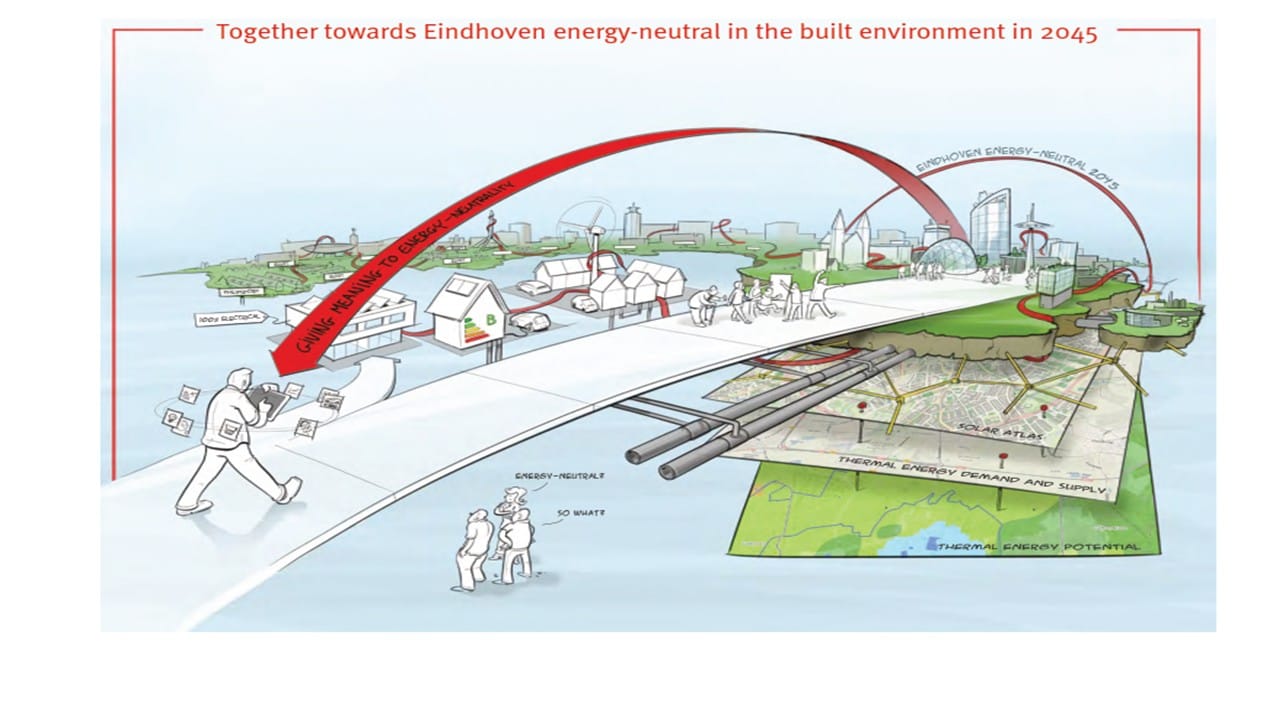
Figure: Backcasting from boundary conditions, as illustrated by the City of Eindhoven.
Strategic Takeaway for Leaders at All Levels, Everywhere
Backcasting means envisioning a future in which a desired goal has been achieved. From that imagined future, you reason backwards: what actions, starting today, would have been required to reach it? No robust strategy is possible without it. It is intuitive and aligns with other strategic planning frameworks (such as SWOT analysis). Therefore, even without repeating the full “ABCD-in-Funnel” model, this new reflection is both self-contained and essential for all strategic planning. For recommendations on more in-depth reading, see the fact box below.
There are two main ways of backcasting: one based on robust boundary conditions for the (re)design of goals, and another that remains limited unless combined with the first. The latter is often referred to as scenario planning, which frequently operates without explicit, scientifically grounded boundary conditions for goal setting. In other words, planning proceeds without first agreeing on the constraints that must be respected.
Without such constraints, how do we know whether a scenario is truly attractive—or even possible? Modeling goals in complex systems without boundary conditions quickly becomes misleading. Effective backcasting for real-life strategic planning, therefore, requires that goals be modeled within robust boundary conditions for success.
Such boundary conditions must comply with five criteria:
- Necessary – no more and no less than required
- Sufficient – covering all essential aspects
- General – enabling multiple solution pathways
- Concrete – usable for hands-on planning
- Non-overlapping – ensuring clarity and measurability
Intellectually departing from such boundary conditions of future success is precisely what makes strategic thinking in complex systems possible. Yet robust boundary conditions—though intuitive in areas like chess (checkmate within the rules), football (scoring more than the opposition), or curing cancer (eradicating the last cancer stem cell while safeguarding patient wellbeing)—are generally absent from how we attempt to address the devastating pandemic of unsustainability.
More in Detail
Game theory makes reasoning backwards from goals within boundary conditions intuitive. But this applies not only to advanced domains like chess or medicine—it is something we all do in everyday life.
Consider planning your morning commute. With an open mind to a variety of possible options under each boundary condition, you still operate within them:
(i) arriving on time,
(ii) dressed for purpose, and
(iii) physically and mentally prepared for the day.
You automatically begin your planning by:
(A) defining success within these boundary conditions
(B) assessing your current assets and challenges in that context
(C) exploring possible actions to bridge the gap between B and A
(D) prioritizing among them and acting
This intuitive process helps you avoid arriving late and unprepared.
Why, then, is this obvious way of thinking not mainstream in strategic sustainability planning?
Because early in the sustainability discourse, we first needed science simply to recognize the problem. Our senses do not perceive CO₂ accumulating in the atmosphere, heavy metals increasing in cropland, or (eco)toxins building up in nature and within our own bodies. Without satellite-based observations over time, we cannot even track how fertile land is systematically shrinking at a global scale.
We also do not intuitively grasp the systemic consequences of increasingly powerful technologies interacting with a growing global population—or the risks of using them improperly.
Nor do we readily see how more advanced societal and organizational design, supported by modern technologies and governance, could reverse these trends and transform them into opportunities. Science has shown that a turnaround cannot be achieved by tackling isolated symptoms one by one. Today, however, we have the knowledge required to define boundary conditions for cohesive modeling and strategic planning toward attractive, sustainable futures.
A Very Brief Overview of ABCD Planning
For scalable, sustainable, and attractive goals (A), and the processes (ABCD) to reach them, you follow the same basic logic illustrated above. Once the need to model goals within boundary conditions is understood, shared values and ambitions become essential. These ensure that transitions are not only effective, but also as attractive and cost-efficient as possible.
Through repeated cycles of ABCD-in-Funnel planning, implementation, and follow-up, organizations strengthen their ability to respond to the sustainability imperative—growing in resilience, attractiveness, and innovative capacity, while supporting others across their stakeholder networks.
Although this approach is robust and relatively straightforward—true for all strategic planning and all strategic games—common pitfalls remain. Some of them even muddy the waters of backcasting as such.
A Couple of Typical Ways of Muddying the Waters
The most frequent mistake is simply neglecting boundary conditions altogether (see https://fssd.global/framework-and-method/)—often because leaders have not yet been exposed to them or their strategic value.
Instead, we often hear statements like:
“We use advanced methods such as fuzzy logic and algorithms based on historical and current data to project trajectories towards future goals.”
This is forecasting disguised as backcasting. It risks “bad data in—bad decisions out,” regardless of how sophisticated the mathematics may appear. In my experience, this is very common—and perhaps most destructive—when applied by financial institutions. Their role is to allocate capital where it is most needed—in this case, to help civilization transition toward possible and attractive futures.
“We use sustainability goals such as the UN SDGs, Science-Based Targets, climate neutrality, Circular Economy, Biomimicry…”
These frameworks are valuable—but they are applications/apps, not comprehensive organizational goals designed for systemic and tailor-made planning. Each addresses important aspects, but only parts of the systemic whole. When combined with ABCD-based planning of the Operative System, however, they can enrich idea generation across A, B, C, and D respectively.
“We don’t believe in absolute constraints—only free innovation.”
Yet true freedom in complex systems arises from understanding and respecting constraints. Without this, what appears as freedom becomes the slavery of ignorance.
Fact Box – A Shared Code Behind All Reflections
If you want to explore the most up-to-date version of the FSSD Operative System, please follow any of the links below. To ensure each Reflection remains self-contained, we include only what is necessary in each case. This avoids unnecessary length while minimizing the risk of flawed or oversimplified interpretations of the Operative System’s Funnel, Boundary Conditions, and the ABCD process—common in other sources.
You have four ways to explore:
- Scientific foundation
Access peer-reviewed research:
doi.org/10.1002/sd.3357 - Practical overview
https://fssd.global/framework-and-method/ - Explore and apply
https://www.stepwise.global - How the Operative System “ABCD-in-Funnel” works in practice
- Kalle’s Reflections
- Podcasts and real-world applications
- Courses and learning opportunities
Sign up via the homepage