Kalle reflects, in concrete terms, on an attractive sustainable world at A.
Takeaway for Leaders at All Levels
As earlier reflections within Stepwise Global have emphasized, clever Strategic Sustainable Development (SSD) reflects enlightened self‑interest — in other words, doing well by doing good. Today we have one scientifically validated operative system that is Systemic (considering the whole world), Systematic (supporting stepwise planning where each step prepares the next), and Strategic (strengthening the bottom line from the first step). This is the ‘ABCD‑in‑Funnel’ operative system within the Framework for Strategic Sustainable Development (FSSD) [Footnote 1].
Yet, despite all the success stories from businesses, municipalities, and universities applying this operative system, its diffusion remains too slow given the global urgency. Why? Because, like all complex missions in complex systems — playing chess, curing cancer, or playing football — you must do it to get it. Hearing about it or watching others doing it is not enough to create the intuitive, practical understanding needed for strategic action, monitoring and communication — let alone, to lead such processes.
The prevailing narrative still suggests that competitive advantage from contributing to an attractive sustainable world is naïve, rare, or only possible for others. What is missing is not theoretical weight — the flawed perception is that true and theoretically validated needs for strategic sustainable development are practically impossible. This misconception persists because of longstanding, tradition‑bound flaws in education, governance, and societal design.
“We cannot do this because nobody else does it.”
“We cannot do this because nobody else does it.”
Unless leaders have actively participated in ABCD workshops, confirmation biases often prevent them from even stepping into the room — a pattern well documented in our action research. The fastest and most self-rewarding progress consistently occurs where leaders are actively engaged in applying the operative system. Delegating it to middle management does not suffice.
Why Leaders Feel Stuck
Regardless of rhetoric, many top leaders feel trapped within a global governance landscape that is historically — and now obsoletely — rigged for strategic under‑performance. Innovative measures seem impossible to implement due to deep‑rooted flaws in law, policy, norms and organizational design. These flaws could survive for centuries because both population levels and industrial power were vastly lower than today.
The way out of this dilemma is to choose measures that strengthen today’s bottom line while also preparing pragmatically for future steps — steps that will become unavoidable as we move deeper into the deadly funnel of unsustainability. Insightful strategists already recognize that this transition is mercilessly inevitable.
Making It Easier to Get Leaders Into the Room
Do stressed leaders really need to begin their sustainability journey by modelling their goals and targets anew within the boundary conditions? Could we combine the rules of the game by also supplying tangible, attractive examples — a kind of halfway step — that leaders can grasp and apply more intuitively in their ABCD workshops?
Yes, we can.
Researchers have begun modelling entire global life‑supporting sectors in ABCD workshops, as if they were business organizations, each under redesign to comply with the sustainability boundary conditions. These ABCD models of whole sectors offer concrete, scalable images of attractive futures. Organizations and regions can then relate their own tailormade ABCD work to these sector‑models, to get concrete input for what is scalable versus doomed within the sectors they rely on. This makes planning easier, more inspiring, and clearer from a pedagogical standpoint.
This reflection is about exactly that.
A System‑Wide Picture of an Attractive and Scalable Global Future (See figure).
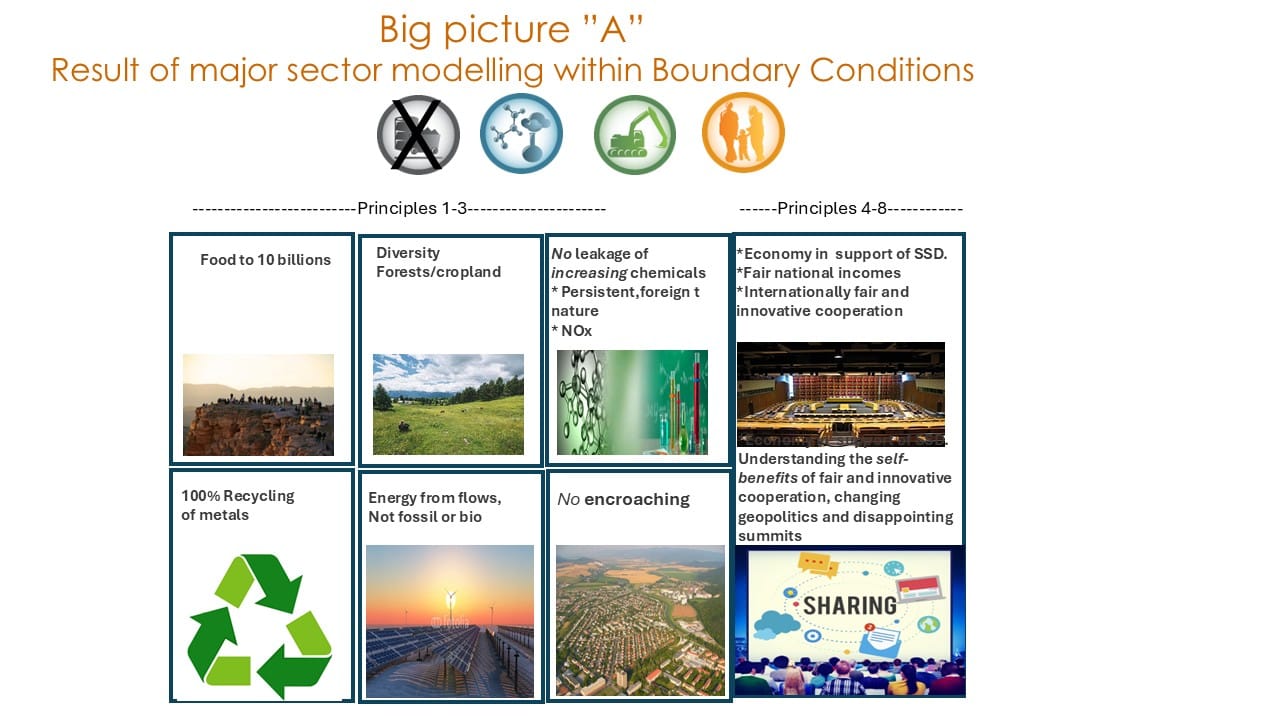
The conceptual figure that accompanies this text illustrates an overview of sectors to see what the world would look like within the boundary conditions. This overview of all sectors and how they are interdependently modelled, provides concrete input to tailormade ABCD analyses of individual organizations and regions. All to avoid stranded assets in suboptimizations and blind alleys , where solutions within one sector run in the face of another. An understanding of the overview will carry most organization’s ABCD workshops far into sophisticated strategic planning. Would a certain topic or organization be particularly dependent on a certain sector, e.g. agriculture, forestry, energy, traffic, construction, materials, more in depth ABCDs of those individual sectors provide valuable input to the organizational ABCDs. This is generally not needed in the beginning av organizational ABCDs when so much is about basic capacity building and discovering major gaps in education, sharing, policy developments and organizational planning. But later on, when more specific questions about optional smart moves may surface during ABCDs, particularly for picking higher hanging fruit regarding technically difficult alternatives, it may be a good practice to click around and search amongst Kalle’s reflections. It could be a car-manufacturer wanting more in depth analyses of the global Traffic and Energy systems. Or, alternatively if answers cannot be found in previous Reflections, ask staff at the Stepwise Global for more in-depth sector analyses. Such sector analyses will also be gradually developed as Apps for downloads on the Stepwise Global platform.
To get it all in perspective, we need to merge three pieces of understanding together:
1. Thriving Forests, Oceans and Biodiversity Are Non‑Negotiable
Forests and marine ecosystems, with their biodiversity, uphold the biogeochemical cycles that sustain all life. Over billions of years, these cycles evolved to regulate climate, water, nutrients, and the composition of chemicals in the biosphere — functions essential for survival of all higher life forms including civilization that can be regarded as a vast living organism, see next piece.
2. Civilization Is an Organism Embedded in Nature
Civilization emerged only about 10,000 years ago, when agriculture allowed people to settle, specialize, and collectively raise quality of life. In a systems sense, civilization behaves like a vast living organism — feeding, breathing, drinking, creating habitats and emitting waste — all constrained by its environment.
Historically, civilization thrived only when its waste streams did not systematically exceed nature’s ability to regenerate fertile soils, biomass, water, or purity by tight regulation of compound concentrations. This balance is no longer true, and we are all suffering from negative impacts including fears of the worse impacts to come, see next piece.
3. Understanding the Few Fundamental Design Flaws That Destroy the First Two Pieces
To design a civilization larger and more powerful than ever before — yet still operating within nature’s limits — we rely on the ‘ABCD-in-Funnel’, the one operative system generically applicable to all topics, organizations, and regions. This system is based on understanding how a small number of basic design flaws of civilizations and organizations, grounded in physical laws, have to destroy nature and society for as long as they are remaining. Putting a “no” to these few design flaws yields the boundary conditions of the FSSD — the theoretically and empirically robust way to plan unsustainability out of the system, rather than trying to fix endless symptoms from not doing it [see footnote 2].
Without this boundary‑condition approach, mainstream attempts to solve isolated issues — for example climate change, toxicity, biodiversity loss, poverty, geopolitical tensions — become overwhelmingly complicated. “Fixing” one area typically worsens another, generating a legitimate systems resistance with unmanageable systemic conflicts.
Why Fossil and Nuclear Fuels Are Not Part of the Future
The modelling at “A”, see figure, begins with an essential physical fact: linear fossil- or nuclear fuel flows cannot be scaled sustainably. This is not ideology — it is physics. See the figure’s crossed over barrels as an analogy for fossil- and nuclear fuels. Thermodynamics and matter‑conservation laws ensure that extracting finite fuels for consumption upstream, cannot be sustainable already for reasons upstream the line. The rest is about trying to foresee safe time limits for further undermining of our common future this way, and such calculated estimates make things rather more acute than reassuring. The same is true downstream the linear fuel flows: increasing ecotoxicity, climate instability, unhealth, statistically unavoidable accidents, wars over declining resources, failures to diplomatically establish sustainable relationships with neighbors, and decreasing quality of life for all. Nobody is safe from the consequences, even if some affluent people, communities and regions may temporarily be able to delay their own consequences – until even abrupter wakeup calls are looming also for them.
Thus, a sustainable future requires a global competition for areas on Earth that capture perpetual energy flows: sunlight, wind, water, waves, currents, geothermal heat. Those resources must be actively struggled for, but not necessarily aggressively – how does a war over sunlight or winds look like? These flows are:
- limitless in human time‑scales,
- far above enough for civilization’s needs,
- free of charge,
- independent of whether we harness them or not.
Over the lifespan of a power plant, the eternal energy flows are free, while declining fuels must be purchased forever. This economic disadvantage of fossil- and nuclear fuels grows steadily. And, because of physical law, it must. Perpetual mobiles are impossible at all scales.
Sector‑by‑Sector Modelling Within the Boundary Conditions
Sustainable Food Systems (Land and Marine)
After the end of linear fuel flows, it is time to model all sectors within the boundary conditions, see figure. In the top‑left corner, we must imagine food systems capable of feeding two billion more people, with protein production as the bottleneck. In the future model, agriculture and forestry coexist rather than compete destructively. Agricultural violations of the Boundary conditions no longer push into forests, nor is forestry degraded by unsustainable practices. At request, and if needed, we can provide more in-depth input to ABCDs in the food sector.
Restored land systems reverse desertification, strengthen regional resilience, function as carbon sinks to counter climate change, and visibly improve quality of life — landscapes that “tell our senses that we can live here.”
Chemicals and Material Flows, boundary conditions 1 and 2.
The future model eliminates systematic increases in concentrations of any compounds — synthetic (e.g., halogenated flame retardants like PFAS) or naturally occurring (e.g., Nitrogen oxides i.e. “NOx)). Achieving this requires:
- Chemicals that degrade quickly and/or are close-loop recycled.
- New business models adapted for such technologies.
- Electrification of traffic to cut around 50% of total NOx emissions.
- Long‑rooted plants and thriving soil microbes in agriculture,
- Pest‑resistant plant varieties,
- Landscape integration and crop‑rotation,
- Nutrient recycling through manure, separated blackwater, and improved sludge purification.
These are examples that protect biodiversity as well as human health; toxicity‑linked diseases are currently rising across all age groups. At request, and if needed, we can provide more in-depth input to ABCDs in the chemical sector.
Metals and Non‑Toxic Elements
Even metals with low toxicity risk under Boundary condition 1, (e.g., aluminum, titanium, iron) must be recycled close to 100% — to secure materials for developing regions and preserve resources for future generations (Boundary condition 7). Other metals should not be recycled at all, but phased out if they are particularly dangerous e.g. uranium and plutonium, or applied in consumer goods where close to 100% recycling cannot be guaranteed. At request, and if needed, we can provide more in-depth input to ABCDs in the metal sector.
Biofuels and Energy Strategy
In the future model, biofuels are not a major energy source. Their inefficiencies across the full life-cycles — harvesting, processing, transport, combustion and reinjection of CO₂ into the atmosphere after use, make them doomed for scaling. But what about “left‑over” biomass from forestry, often claimed to be better off as fuels than being wasted? But once collected even for this purpose, why not increasing their value as feedstock for long‑lived materials and soil restoration? At request, and if needed, we can provide more in-depth input to ABCDs in the energy sector.
Physical Encroachment and Land Use
Future civilization avoids any further physical encroachment, and revert it to the opposite:
- no large clear‑cuts,
- no overfishing,
- no urban sprawl
- restoration of desertification into fertile land by new ways of keeping cattle, using left over biomass to restore soils etc.
When it comes to city-planning, this requires “decentralized concentration”: compact, well‑connected settlements surrounded by fertile land. Everyday needs are walkable through elegant and resource saving logistics and transports. Suburbs and cities are connected by trains and boats. Smart grids and sharing economies are standard. At request, and if needed, we can provide more in-depth input to ABCDs in the spatial planning sector.
Social and Economic Consequences of the Sector Models
On the right side of the figure are social sustainability conclusions.
Humanity is currently trapped in rising interpersonal mistrust as well as mistrust between people and institutions/authorities. Since is is people degrading ecosystems, people — cooperating across cultures and nations — must restore them.
A key underlying mechanism is abuse of power, reflected in a “proxy” i.e. today’s extreme inequalities in income and wealth. Where incomes often come from earning money from having money, i.e. are disconnected from work. Addressing this correctly further improves on individual bottom lines by:
- Sharing responsibility for natural resources,
- Fair distribution of manufactured capital,
- Innovative taxes and policies rewarding cooperative work at the global scale,
- Dissemination of business models aligned with long‑term societal well‑being.
- Changing themes of all those summits from “who is to blame and who is to pay” to “how can all benefit from true cooperation across all nations and communities”?
- Getting rid of our dependencies of linear fuel flows (see above), as a mechanism to restore our whole system with its norms, laws, policies, and economies.
This perspective is essential not only in geopolitics and ecosystem summits but also for industrial and financial innovation of scalable futures.
For more detail, surf around on the Stepwise Global homepage.
Also take a look at the Footnotes:
- Broman, G.I., Robèrt K.‐H., 2017. A framework for strategic sustainable development. Journal of Cleaner Production 140: 1.
- The boundary conditions for modelling of futures that can be scaled and attractive are:In the sustainable society (scalable future), nature is not subject to systematically increasing:1 …concentrations of substances extracted from the Earth’s crust, e.g., fossil carbon, minerals and metals.2 …concentrations of substances produced by society, e.g., NOx and CFCs.3 …degradation by physical means, e.g., over‐harvesting of forests and overfishing.…and people are not subject to structural obstacles to:4 …health, e.g., by dangerous working conditions or insufficient rest from work.5 …influence, e.g., by suppression of free speech or neglect of opinions.6 …competence, e.g., by obstacles to education or insufficient possibilities for personal development.7 …impartiality, e.g., by discrimination or unfair selection to job positions.8 …meaning making, e.g., by suppression of cultural expression or obstacles to co‐creation of purposeful conditions.