ABCD Workshops: Stunning, Effortless Results for Leaders
Kalle reflects on the psychology of ABCD-in-Funnel workshops
Key takeaway for leaders, facilitators, and co-creators
Two human factors determine the impact of ABCD-in-Funnel workshops. (i) First, a skilled moderator who turns methodology into psychological craftsmanship. (ii) Second, a genuinely engaged top management that participates actively, every now and then, in workshops to innovate, set direction, lend legitimacy, and allocate resources for real change outcomes.
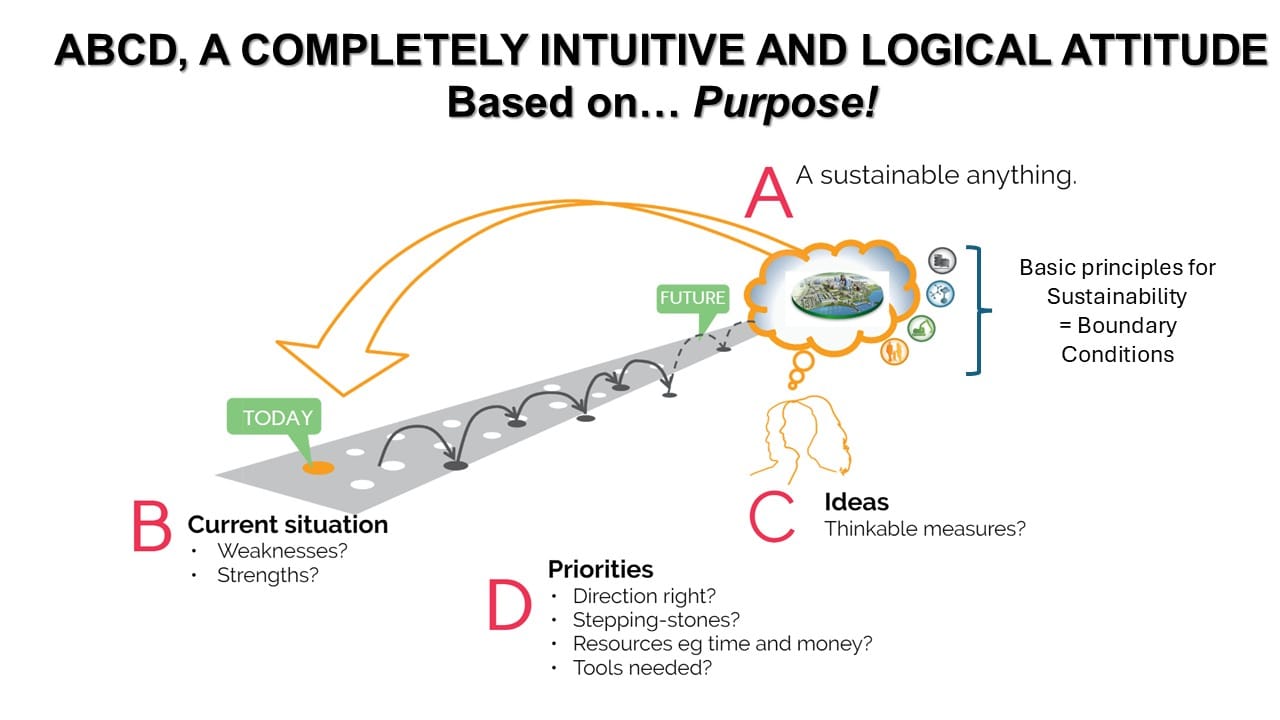
When these conditions are met, the ABCD method (see figure, and footnote) becomes a powerful engine for strategic sustainable development. Done well, the art of psychologically intelligent moderation transforms a traditional workshop group of individuals—from ideas scattered all over the place on Post-its and Flipcharts—into one integrated brain for systematic analysis, planning, reporting and action.
- Why the moderator’s role is psychological
The moderator’s role in ABCD-in-Funnel workshops is fundamentally psychological as much as it is methodological. You stand at the whiteboard not merely to capture content, but to guide attention, flow, and safety. So that the whole group’s diverse skills and experiences, structured around one and the same Operative System for change, can emerge. Just like clever footballers do not only individually master the ball. In the end it is about team work based on (i) the rigorous rules of the game, (ii) a sharp principled definition of winning (iii) a diversity of skills to make it happen together and a referee/moderator safeguarding the rules without taking active part with the ball.
Let ideas move fluidly and put them on the whiteboard where they belong under the “rules” A, B, C, or D respectively. This mirrors how neural networks in the individual brain produce insight—now scaled across many minds, like a tight football team. Listen closely to each proposal. Learn to summarize proposals in a few words, written in neutral “telegram” style, and place each “telegram” where it belongs under A, B, C, or D respectively. Verify with the contributor that you captured it correctly so that the note will trigger the full memory of the proposal and support later reporting. Over time, this trains the group to think systemically, individually as well as in the group. The ABCD logic becomes second nature, raising performance workshop after workshop, especially when ABCD becomes part of ongoing effective organizational development. Just like your game of football will improve more from playing the game, than reading about it.
The telegram style: fast, neutral, collective memory
So, for every contribution:
– Capture it briefly and place it under A, B, C, or D.
– Confirm accuracy with the contributor.
– Move on, enabling a continuous ping-pong of ideas.
It’s a good habit to cluster related topics within nearby brackets in the B, C, and D columns to maintain clarity and cohesion. Do not attempt to exhaust each topic before allowing new ones to surface; participants bring issues forward for a reason, at any time and based on the conversation. And you can always circle back to refine previous items within their brackets.
The ping-pong flow of group intelligence
In ABCD-in-Funnel workshops, a proposed idea for future success under, say A, may spark a current problem under B with a possible solution under C. A solution that someone notices already exists in small scale under B. Which then invites a proposal for scaling under C, perhaps meriting an early move to be prioritized under D. Another participant may then surface a fresh and new problem under B, elegantly solved by a measure put under C. This may solve the earlier problem, thereby hitting two birds with one stone. All allowed by the free ping-pong flow.
This structured, yet uninterrupted ping-pong of insights, is the core of ABCD intelligence. Once participants grasp the “game,” the group begins to generate, correct, and integrate ideas fluently. The collective intelligence rises because everyone shares an absolute code for the “game”, that anchors creativity, systems thinking, and innovation. Just like the footballers with their diverse sets of skills in the example above.
Protecting flow and psychological safety
Above all, the moderator safeguards two things: the logic and flow within the ABCD-in-the-Funnel structure by just putting “telegrams” where they belong, and an atmosphere of psychological safety that enables fearless, free associations in group work. Ideas can be excellent even if first suggested to be put under the “wrong” letter A, B, C or D. Simply acknowledge, “Excellent,” and place ideas where they belong. Avoid early correct/incorrect judgments—they stifle creativity and systems thinking before they can bloom. Once you begin to witness all the “aha’s” in the group, you realize that this is more fun too.
Facilitators are often invited to evaluate specific proposals in the group. That is a delicate moment, calling for some resistance. Refrain from judging or advising one idea as better than another, even if asked. Instead, respond inclusively: “Good question. Here is how another company approached this dilemma… and here is how a region handled it…how do you think about this?” This avoids shutting down contributors while still gently steering the conversation by relevant inputs from neutral ground. When done well, refinements begin to emerge naturally from the group itself—a sign that the shared brain is “getting it” and begins operating and enjoying as intended.
- When and how to use breakouts
Breakouts enhance participation by giving space for both reflection and rehearsal. They help more introverted participants articulate doubts and shape new proposals, while giving more extroverted colleagues a chance to test and iterate ideas before the group brings them to the whole room.
Brakeouts as beehives in big lecture halls. Breakouts need not be solely the organizer’s preplanned table work. A moderator can initiate them on the spot, even in large lecture halls. A productive sequence could be:
– 45 minutes presentation of the ABCD-in-Funnel rationale with analogies and case studies for clarity,
– followed by 15 minutes of “beehive” conversations in pairs or trios where people happen to be seated,
– followed by 30 minutes of Q&A in plenum, after everyone has had the opportunity to exchange and test initial thoughts in the beehives.
If the organizers takes notes during the plenum Q&A that follows, those notes become part of co-creating the report—delivering a one-brain result even after only a two-hour session in a large lecture hall.
Guidelines for more formal table breakouts
– Let people choose their own tables or clusters. This supports established collaborations as well as new networking. The rational is curiosity and other creative drivers amongst adults who are respected to apply their own judgements. This is opposed to a common and uncalled-for interfering and enforcement; “all who has got number 1 go to that table, all who has got number 2 to that table”.
– Each table selects a chair who keeps time and takes brief notes.
– After breakouts, reconvene in plenum. The moderator now guides a deeper dialogue, enriched by what surfaced at the tables.
– Collect table notes, plenum notes, and all scribbles from the tables.
Creating a shared draft
Immediately after the session, the organizer and moderator compile a single integrated ABCD draft of the whole session. Send it out to participants for comments, then distribute a final version before the next workshop. This simple discipline can sustain coherence across large, complex groups, even across value chains and larger stakeholder networks, and builds a durable record of learning and decision-making in large teams sharing the same rules of the game.
Follow-ups: keeping the ABCD process alive
Sustained momentum turns workshops into a continuous learning loop. Invite participants back by explicitly linking the next session to the last. For example:
“Dear participant of the previous ABCD workshop one month ago. Two weeks from now, we reconvene to review what has then been done under the decision log we created under D, what new problems have appeared under B since then, and what this means for our upcoming round of collective ABCD co-creation.”
This enables self-corrections of previous decisions, anchors accountability, deepens systems thinking, and accelerates practical progress and learning-by-doing.
From Post-its and Flipcharts to a Unified Mind
No more nervous presenters confined to post-its, unrehearsed presentations on flipcharts that nobody reads afterwards, interrupted listening, “lock-ins” by forcing participants to focus on one specific topic at a time, all leading to fragmented documentation and little or no action. “Climate change” can, for instance, not be solved by narrowing in on climate which inherently leads to “solutions” that make things worse in some other sector, e.g. energy, traffic, agriculture, socially or economically. Moving away from the more traditional forms of workshops, honors and amplifies the collective knowledge of large assemblies. Inherently larger amounts of data from people with diverse skills and experiences, can now be also cognitively put together by mimicking how intelligent innovative minds work.
The leadership imperative
ABCD-in-Funnel workshops thrive when senior leaders are visibly and authentically taking part in at least some workshops now and then. We have shown, in peer-reviewed science, how their presence increases innovation, signals seriousness, provides context, and unlocks resources. It also shortens the distance between insight and implementation. When leaders do this, the workshop output becomes a living, pragmatic strategy for real change rather than a stack of notes.
Am i overstating this way of workshops? Perhaps, some workshops may be consciously planned to let everybody talk about just anything. The intent could be diagnostic, to learn what “people are at right now”. Post-its and Flipcharts may suit such workshops. But this is certainly not true when it comes to the team work of ABCD-in-Funnel workshops. Where the shared knowledge is a set of precis rules and definition of winning. Combining this rigorous way of systems thinking and modelling with an old-timer structure for workshops, is a certain mismatch. A lost opportunity.
Conclusion: mastering the craft of ABCD-in-Funnel workshops
succeeds when moderators combine psychological craftsmanship with strategic competence. Do this consistently, and you will transform scattered inputs from your team, into a single, super-knowledgeable, super-experienced, super-cognitive brain for strategic sustainable development—ready to implement, improve, and scale.
Footnote: See www.fssd.global or the open‑access scientific article on the Operative System: https://doi.org/10.1002/sd.3357
Karl-Henrik Robèrt (Kalle)
Professor, Blekinge Institute of Technology
Campus Gräsvik, Valhallavägen 1
SE-371 79 Karlskrona, Sweden
Phone: +46 455 38 50 00
www.bth.se/eng
Blekinge Institute of Technology helps you take strategic steps toward sustainability.
Research for Real Change | Training for Leaders | Coaching for Role Models | A Movement for Change